When Florida HOA Lakes Need Cyanotoxin Testing
A green shoreline near a dog-walking path deserves attention before anyone knows whether the bloom contains toxins. For HOA boards, cyanotoxin testing for Florida lakes becomes important when suspicious blooms, possible exposure, or recurring problems raise a safety question.
Most community retention ponds aren't swimming areas, but residents, pets, golfers, and maintenance crews still approach the water. Limit exposure first , then arrange an assessment that separates ordinary algae growth from a possible harmful bloom.
The testing decision starts with what changed, where it happened, and who could contact the water.
When Cyanotoxin Testing Belongs in the Response
A suspected cyanobacterial bloom warrants prompt evaluation. However, every green patch doesn't require the same laboratory work. A qualified inspection helps distinguish cyanobacteria, other algae, floating plants, and storm-related discoloration.
Suspicious scum or a sudden color change
Cyanobacteria, often called blue-green algae, can resemble spilled green paint, pea soup, or a teal surface film. Wind may concentrate scum along one shoreline while the opposite bank looks normal.
These observations support assessment and possible toxin testing, especially near docks, walking paths, irrigation intakes, or frequently accessed banks. Reviewing blue-green algae warning signs helps staff document changes consistently.
Color alone doesn't establish toxicity. Duckweed and watermeal can also cover a surface, while some cyanobacteria remain dispersed below it. Identification and toxin testing answer different questions.
Possible exposure or repeated bloom reports
A report of illness after lake contact deserves immediate attention, even before testing confirms a cause. Direct residents toward medical care and pet owners toward a veterinarian when symptoms follow suspected exposure.
The board should record the lake, location, date, activity, and visible conditions. Those details help professionals choose sampling locations and evaluate risk.
Recurring blooms also justify a testing discussion. A pond that repeatedly develops scum beside a public-facing amenity needs a stronger response than occasional algae in an inaccessible corner.
Why a Routine Water Panel Isn't Enough
Routine lake measurements help explain growing conditions. They don't establish whether cyanotoxins are present, and a standard water-quality package may exclude toxin analysis entirely.
Nutrients and chlorophyll-a show different conditions
Phosphorus and nitrogen measurements help identify nutrient pressure. Chlorophyll-a indicates algal biomass, while dissolved oxygen and pH reveal other conditions affecting fish and treatment decisions.
None of these measurements substitutes for cyanotoxin testing. A high chlorophyll-a result doesn't prove toxin production, and a normal oxygen reading doesn't rule it out.
Boards should also separate bacterial concerns from bloom concerns. E. coli testing addresses fecal contamination, not cyanotoxins. Following sewage intrusion, a property may need bacterial testing even when the water looks clear.
Ask which toxins the laboratory measures
Microcystins and cylindrospermopsin are two cyanotoxins commonly discussed in freshwater guidance. Other targets include anatoxin-a and saxitoxins.
Before ordering analysis, describe the suspected bloom, known history, and potential exposure. Ask the laboratory which toxin targets and methods fit that situation.
A negative microcystins result doesn't answer whether another toxin is present. Understanding HOA lake water test results starts with checking exactly what the laboratory measured.
Florida's Bloom Response Has Limits for Private Lakes
Florida's public-health guidance distinguishes visible bloom concerns from confirmed toxin detection. HOA boards should understand that distinction without assuming a private retention pond follows every procedure used for public waters.
Health Caution and Health Alert mean different things
The Florida Department of Health describes a Health Caution when a bloom is visually detected or cyanobacteria dominate a sample. A Health Alert applies when cyanotoxin is present.
The state's public guidance doesn't identify the EPA recreational numbers as Florida's numeric alert thresholds. Therefore, boards shouldn't wait for a particular concentration before restricting contact with visibly affected water.
For a private lake, coordinate notices and response decisions with the county health department or other responsible agency when appropriate. An HOA notice shouldn't imply that an agency issued an official advisory unless it did.
Private waters need their own testing arrangements
Florida DEP's bloom-response sampling covers public freshwater bodies. Its state response doesn't sample privately owned waters, so an HOA may need to arrange professional collection and laboratory analysis itself.
First, confirm ownership and responsibility rather than assuming a lake beside a community belongs to the association.
Florida accepts bloom reports at 1-855-305-3903 . Reporting can support agency awareness, but it doesn't replace private-lake precautions or an HOA sampling plan.
Build a Sampling Plan for the Affected Lake
A useful sample answers a defined question. Collecting water wherever access is easiest can miss the exposure area or fail to describe conditions across a multi-lake property.
Match locations to exposure and drainage
Tell the sampling professional where residents reported scum, where dogs approach the water, and where crews work. Include irrigation intakes and other points where water use could create exposure.
Wind direction matters because concentrated shoreline scum may differ from open-water conditions. Depending on the question, both locations may need separate samples.
For connected lakes, identify each basin and the direction of water movement. One lake's result shouldn't automatically characterize neighboring ponds. Keep samples tied to individual locations instead of combining them without a laboratory-approved reason.
Follow laboratory handling instructions
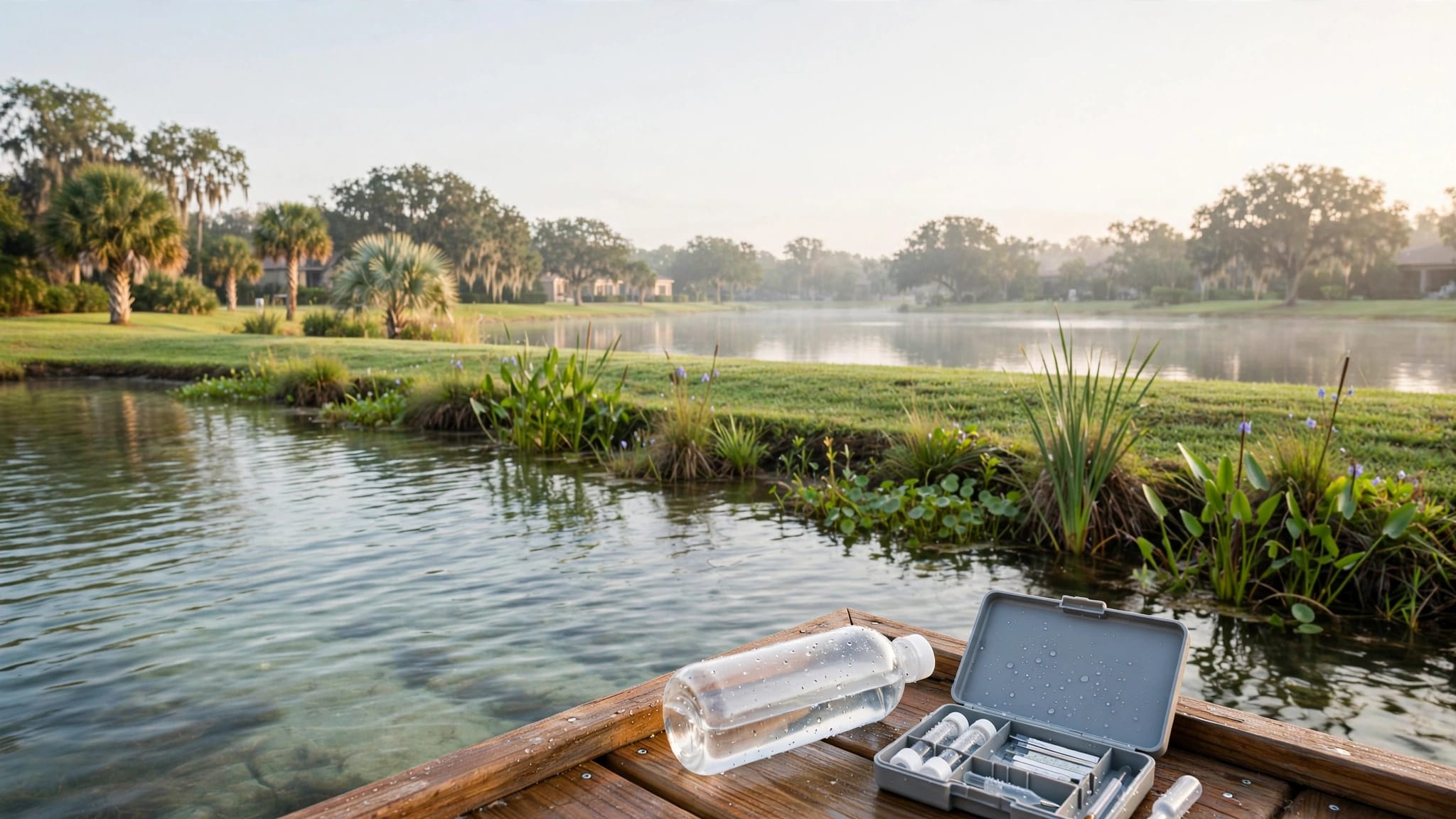
The laboratory should specify containers, preservation, transport conditions, and holding times before collection. Ask whether the analysis measures dissolved toxin, toxin associated with cells, or both.
Record the date, time, lake identifier, exact location, weather, visible bloom conditions, and recent treatment history. Photographs provide useful context, but they don't replace sample documentation.
Following water sampling chain-of-custody procedures helps preserve a reliable record from collection through reporting. Ask about turnaround time before sampling, particularly when access restrictions depend on follow-up results.
Untrained staff shouldn't enter suspicious water to retrieve a sample.
Protect Residents and Workers While Results Are Pending
Waiting for laboratory results doesn't mean leaving access unchanged. Florida DOH advises people to stay away from water containing blue-green algae and avoid swimming in or around it.
An HOA's immediate response should address actual exposure points:
- Restrict water contact near affected areas, including wading, pet drinking, and shoreline activities that involve touching the water.
- Notify residents, landscape crews, irrigation personnel, and other contractors about the affected lake and temporary precautions.
- Photograph changes from safe locations and keep a dated record of reports, restrictions, and professional recommendations.
Don't use bloom-affected water for spray irrigation. Staff should also avoid raking scum or disturbing it with boats and equipment before evaluation.
If someone contacts the water, Florida DOH recommends washing with soap and water. Boiling doesn't eliminate cyanotoxins, so it isn't a way to make affected lake water safe.
Keep updates factual. State what staff observed, what testing is underway, and which restrictions remain active.
Read Toxin Results Without Overstating Safety
A laboratory report needs context: toxin target, method, reporting limit, sampling location, and collection time. For cyanotoxin testing in Florida lakes, the number alone rarely answers every management question.
EPA recreational recommendations aren't Florida posting rules
EPA's 2019 recreational recommendations identify 8 micrograms per liter for microcystins and 15 micrograms per liter for cylindrospermopsin for swimming advisories.
Those figures are EPA recommendations. They aren't the numeric Florida alert thresholds described in the state's public guidance, nor universal reopening criteria for every HOA lake.
A retention pond's use matters. So do applicable agency directions and the possibility of pet exposure. Boards can review Florida lake water-quality action thresholds while developing a response tied to local conditions.
A nondetect describes a particular sample
"Nondetect" means the laboratory didn't detect the tested substance at its stated reporting limit. It doesn't establish that every toxin is absent throughout the lake.
Blooms move and change, so a shoreline sample taken Tuesday may not describe another cove on Friday. Likewise, reduced surface scum doesn't prove that toxin concerns have ended.
Keep precautions tied to professional assessment and relevant agency guidance. Follow-up sampling may help determine whether the problem persists, particularly after a positive result or a major change in conditions.
Positive Results Need Corrective Work, Not Testing Alone
After toxin detection, maintain appropriate exposure restrictions and review the next steps with the laboratory, lake professional, and responsible agencies. Then investigate why the bloom developed.
Repeated sampling can track the problem, but it won't correct the conditions feeding it.
Investigate nutrients and uneven circulation
Inspect drainage inlets, fertilizer practices, grass clippings, pet waste, eroding banks, and accumulated organic debris. These sources can increase nutrient loading in community stormwater lakes.
Also evaluate stagnant coves and uneven circulation. A strong fountain spray doesn't establish that the entire basin receives adequate mixing or oxygen.
On golf courses and multi-lake properties, compare affected basins with their own historical conditions. Differences in depth, drainage, and shoreline access can require different maintenance decisions.
Coordinate treatment and follow-up
Some treatments damage cyanobacterial cells and can release intracellular toxins. Therefore, treating visible growth requires more care than applying an algaecide and judging the color afterward.
Algae decomposition also consumes oxygen. Treatment planning should account for fish stress, product labels, water uses, and follow-up measurements.
Seabreeze Lake Maintenance serves Southwest Florida HOA communities and golf courses from Fort Myers. It holds Commercial Applicator License #CM28291 and State-Licensed Specialty Contractor #SCC131152136 . A lake assessment can help connect bloom observations with drainage, shoreline, and maintenance needs; laboratory toxin analysis remains a separate diagnostic step.
Key Takeaways for HOA Boards
- Suspicious blooms justify immediate exposure precautions, while laboratory testing determines whether the selected cyanotoxins were detected.
- Private HOA lakes may need privately arranged sampling because Florida's state bloom-response program doesn't sample privately owned waters.
- A useful result connects to a documented location, an appropriate test, and a corrective plan rather than a blanket safety claim.
Make Testing Part of a Clear Lake Response
A green shoreline beside a community path calls for prompt assessment and clear exposure precautions . Cyanotoxin testing helps answer a specific safety question, but its value depends on representative sampling and careful interpretation.
For Florida HOAs, the strongest response combines resident communication, targeted testing, and corrective maintenance. Keep each decision tied to the affected lake, its actual use, and documented conditions.
Recent Posts