Wild Taro Problems in Florida Community Lake Systems
Wild taro can turn a clean retention pond shoreline into a dense wall of tropical leaves. For HOAs, golf courses, and gated communities, wild taro Florida problems affect more than appearance. Large stands can block access, hide eroded banks, crowd out desirable shoreline plants, and create recurring complaints from residents.
The plant often starts in a shallow, wet area and spreads along the water's edge. Removing visible leaves may produce a short-term improvement, but underground structures can support new growth. Effective control begins with correct identification, a site inspection, and a treatment plan that fits the lake's drainage, vegetation, and use.
Key Takeaways
- Wild taro grows in wet soil and shallow water, especially along retention pond edges.
- Large arrow-shaped leaves can hide erosion, limit access, and reduce shoreline visibility.
- Cutting or pulling the plant often leaves underground corms that produce new growth.
- Professional control should account for nearby desirable plants, wildlife, drainage, and water uses.
- Licensed aquatic weed management and regular follow-up are more reliable than one-time removal.
Why Wild Taro Becomes a Problem Around Community Lakes
Wild taro, commonly known as elephant ear, is a large wetland plant in the Araceae family. Its broad leaves can make a shoreline look lush at first, but dense growth becomes difficult to manage when the plant spreads beyond a small, planned planting area.
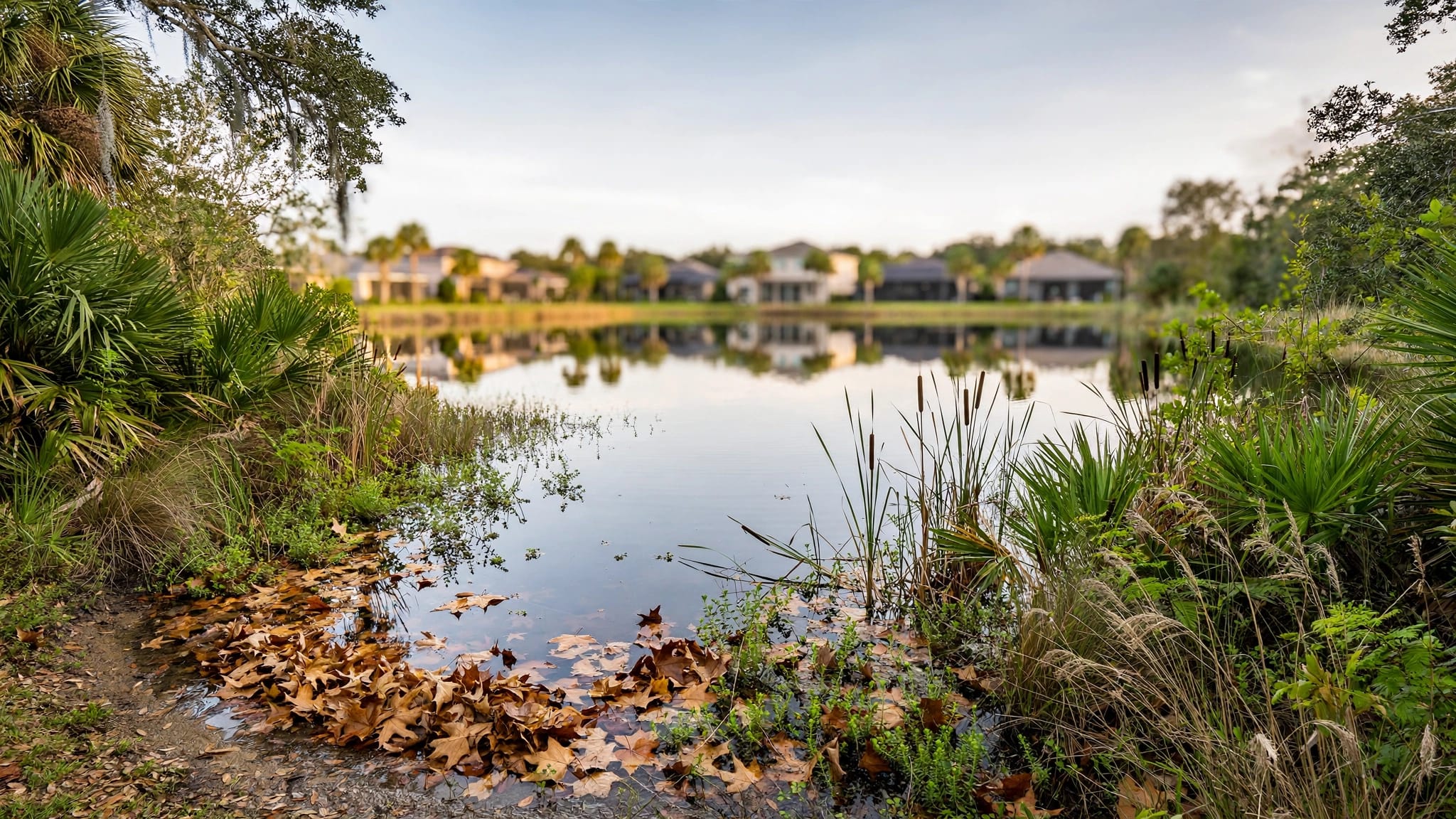
In Florida communities, wild taro commonly grows along shallow shorelines, drainage swales, pond banks, and areas that stay wet after rain. Retention ponds with gradual edges provide suitable conditions because the plant can grow in saturated soil without remaining fully submerged.
A small patch can expand when corms and plant fragments remain in the soil. Mowing may remove the leaves without eliminating the underground portion. Heavy equipment can also disturb the bank and spread plant material to nearby areas.
The plant creates several practical concerns for property managers:
- Reduced visibility: Tall leaves can block views across shallow areas and make shoreline inspections harder.
- Limited access: Dense stands can prevent crews from reaching the water's edge.
- Hidden erosion: A thick plant canopy may conceal bank loss, exposed roots, or damaged littoral zones.
- Poor curb appeal: Unmanaged growth can make a maintained community lake look neglected.
- Maintenance conflicts: Broad leaves may interfere with mowing, drainage inspections, and landscape work.
Wild taro can also contain calcium oxalate crystals, which can irritate the mouth and skin if plant tissue is chewed or handled improperly. Residents, children, and pets shouldn't be allowed to disturb unknown shoreline plants.
How to Identify Wild Taro in Florida Retention Ponds
Correct identification matters because treatment depends on the plant's structure, location, and growth pattern. Wild taro has large, upright leaves that often point upward from thick stalks. The leaf shape can resemble an arrowhead, heart, or shield, depending on the plant and its growth stage.
The stalk usually attaches near the lower portion of the leaf rather than at the center. That detail can help separate wild taro from other elephant ear species and from several ornamental plants used in Florida landscapes.
Wild taro is often confused with:
- Alocasia species
- Caladiums
- Ornamental elephant ears
- Canna lilies
- Pickerelweed and other broad-leaved wetland plants
A shoreline crew should inspect more than the leaf. Look at the stalk arrangement, leaf attachment, root or corm structure, and exact growing location. A plant in a landscaped bed may need a different response than a naturalized stand spreading along a pond bank.
Season also affects identification. During periods of active growth, the leaves are easier to recognize, but older or damaged stands may appear as broken stalks and scattered leaf remnants. If a community has already cut the plants, a technician may need to inspect the remaining corms and nearby regrowth.
Plant identification should happen before herbicide selection. Treating the wrong species can waste money, injure desirable vegetation, or leave the original problem untouched. It can also complicate compliance when a treatment reaches open water or a drainage connection.
Why Cutting and Pulling Wild Taro Often Fail
Physical removal can help in small, accessible areas, but it isn't automatically a complete solution. Wild taro can regrow from underground corms, which store energy and produce fresh shoots after the leaves are cut.
Pulling plants may remove some roots and corms, yet disturbed soil can leave pieces behind. The work can also create bare shoreline areas that wash into the lake during heavy rain. On larger properties, repeated manual removal may cost more than a planned aquatic vegetation program without delivering lasting control.
Mowing creates another risk. Standard mowing equipment may chop leaves and stalks into pieces, move material along the bank, and damage the soil surface. It may also leave an uneven shoreline that increases the chance of erosion.
A shoreline can look clear after cutting while the underground corms remain active below the soil.
Treatment timing matters as well. Mature aquatic weeds and shoreline plants can resist control when dense growth prevents full contact with the active tissue. Water movement, plant stress, and incomplete follow-up can also reduce results. Properties dealing with recurring growth can review why lake treatments fail on dense weeds before choosing another one-time application.
Mechanical removal may still have a place. Crews may use it when a stand blocks an access point, when debris must be cleared, or when removing dead material after treatment. The method should match the site's size, bank condition, water level, and disposal requirements.
A Safer Approach to Wild Taro Florida Control
Wild taro Florida control should start with a complete inspection, not an automatic chemical application. A qualified lake maintenance provider should map the affected areas and document the plant's density, water depth, nearby vegetation, and relationship to stormwater structures.
The inspection should also consider:
- Whether the growth is in open water, saturated soil, or a landscaped buffer.
- Whether the pond connects to another lake, canal, wetland, or drainage system.
- Whether desirable littoral plants grow within or beside the affected area.
- Whether residents, golfers, pets, or maintenance crews use the shoreline.
- Whether erosion or poor drainage is helping the plants spread.
After identification, the provider can select an appropriate control method. Aquatic herbicides may help when applied to the correct plant and location by a licensed professional. The label, waterbody conditions, weather, and nearby uses all matter. A trained applicator should also account for restrictions involving irrigation, fishing, swimming, and water discharge.
Dense stands may require more than one visit. A first treatment can affect mature leaves, while later inspections identify new shoots and missed plants. Crews may remove dead material when it creates an obstruction or lowers the property's appearance.
A broader maintenance program often produces better results than emergency service after the shoreline is covered. Seabreeze Lake Maintenance provides integrated algae and aquatic weed control, with inspection, plant identification, selective treatments, mechanical work when needed, and scheduled follow-up.
The work should protect more than the target plant. A healthy lake system may include beneficial shoreline vegetation, fish habitat, and littoral plantings that help stabilize the bank. Removing every plant along a pond edge can create new erosion and water-quality issues.
How Wild Taro Affects HOA and Golf Course Maintenance
HOA boards and golf course managers often inherit wild taro problems as part of a larger shoreline issue. The same pond may have algae, invasive grasses, fallen branches, sediment buildup, or damaged banks. Treating one plant without examining those conditions can lead to repeated service calls.
For HOAs, the visible problem is often resident dissatisfaction. Leaves may cover an attractive water view, grow beside walking paths, or create an unmaintained appearance near homes. The hidden issue is access. If crews can't see the shoreline, they may miss erosion, clogged outfalls, or damaged signs and fencing.
Golf courses face additional concerns. Wild taro near tees, cart paths, drainage areas, and water hazards can affect play and maintenance routes. Equipment operators need clear boundaries around treated areas and wet banks. A planned schedule helps the course coordinate aquatic work with mowing, irrigation, and regular play.
Multi-lake communities also need consistent records. A lake map can show where wild taro appears, how quickly it returns, and whether the growth follows a drainage path. Photos taken from the same locations make changes easier to evaluate during board meetings and vendor reviews.
Weekly or biweekly inspections may be appropriate for properties with recurring aquatic weed growth, heavy stormwater flow, or high visibility. Other sites may need seasonal visits. The right frequency depends on plant pressure and the property's risk, not a generic calendar.
A lake maintenance plan should track:
- Wild taro and other aquatic weed locations
- Algae growth and water clarity
- Shoreline erosion and exposed soil
- Drainage structures and water levels
- Debris, fallen trees, and access conditions
- Aeration equipment performance
- Desirable littoral plant health
Routine observation helps crews treat small patches before they become shoreline-wide problems. It also gives property managers useful documentation when residents ask why maintenance is scheduled at a certain time.
Prevention Through Shoreline and Water Management
No maintenance plan can guarantee that wild taro will never return. However, better shoreline management can reduce the conditions that support repeated spread.
First, avoid unnecessary disturbance. Bare, wet soil gives opportunistic plants room to establish. When appropriate, a stable littoral planting plan can protect the bank and reduce open areas where unwanted vegetation takes hold.
Next, inspect drainage patterns. A leaking pipe, blocked outfall, or constantly saturated low spot may keep one section of the shoreline wetter than the rest. Correcting the drainage problem can support long-term control, although changes to stormwater systems should follow local requirements and professional guidance.
Shoreline stabilization may also be needed where plant removal exposes loose soil. Crews should evaluate the bank after treatment and repair areas that could wash into the pond. Sediment and nutrient runoff can add stress to the waterbody and encourage algae growth.
Water quality matters because a neglected pond often develops several connected problems. Algae, aquatic weeds, poor circulation, and shoreline erosion can reinforce one another. Aeration, nutrient management, debris removal, and scheduled vegetation control should work together when site conditions call for them.
Property managers should also use caution with do-it-yourself removal. Residents may not know which plants are protected, which treatments are approved for aquatic use, or how to dispose of plant material. Florida aquatic applications require proper licensing and label compliance.
Seabreeze Lake Maintenance operates with Commercial Applicator License #CM28291 and State-Licensed Specialty Contractor #SCC131152136 . Those credentials support responsible service for community lakes, golf courses, retention ponds, and other managed water systems in Southwest Florida.
For a property with spreading shoreline vegetation, a Free Lake Health Assessment can help identify wild taro, related maintenance concerns, and practical next steps.
Conclusion
Wild taro can become a costly shoreline problem when a small patch goes unnoticed. Its broad leaves reduce visibility, limit access, and hide conditions that deserve attention, while underground corms make repeated cutting an unreliable solution.
The strongest plan combines accurate identification, licensed treatment, careful mechanical work, shoreline protection, and follow-up inspections. For Florida communities and golf courses, early lake maintenance is easier to manage than a dense stand that has spread across several pond edges.
Recent Posts