How to Identify Eurasian Watermilfoil in Florida HOA Lakes
A feathery underwater plant can look harmless until it reaches the surface and forms a dense, tangled mat. In Florida retention ponds and community lakes, early identification helps an HOA address the problem before it blocks views, restricts access, or interferes with lake maintenance.
Questions about Eurasian watermilfoil Florida lakes often start when a manager notices fine green leaves near the shoreline. The plant can resemble beneficial vegetation, hydrilla, or coontail, so appearance alone isn't always enough. Learn the main field marks before anyone pulls plants or orders a treatment.
Why Eurasian Watermilfoil Matters in Community Lakes
Eurasian watermilfoil, or Myriophyllum spicatum , is a submerged aquatic plant rooted in lake or pond sediment. Its stems can grow upward through the water column, then spread near the surface. Dense growth may create a thick underwater bed that becomes visible as a mat beneath calm water.
For an HOA or gated community, the concern goes beyond appearance. Heavy growth can crowd native plants, obstruct fishing areas, collect floating debris, and limit access for residents or lake service crews. In a retention pond, dense vegetation can also make inspections more difficult around outfalls, banks, and drainage structures.
The plant spreads through seeds and small stem fragments. A fragment can move with water, equipment, wildlife, or storm activity. That makes careless removal risky. Pulling a mature stem and leaving pieces behind may spread the problem to another part of the same lake.
Watermilfoil also changes how a maintenance team plans treatment. A plant that looks thin along the bank may have a much larger bed below the surface. Integrated aquatic weed control begins with identifying the species, mapping its density, and reviewing water conditions.
These steps apply to retention ponds and community lakes managed by HOAs, golf courses, apartment communities, and other multi-lake properties. They aren't intended for ornamental koi ponds.
Eurasian watermilfoil Florida Identification Starts With the Leaves
The most useful clue is the plant's leaf structure. Eurasian watermilfoil has soft, finely divided leaves that look like small feathers. The leaves grow in whorls around the stem, with several leaves attached at each point.
A typical whorl contains four or more leaves, although the arrangement can vary with growing conditions. Each leaf has many narrow leaflet pairs, giving the plant a delicate, comb-like appearance. When you lift a stem from the water, the leaves often spread outward instead of remaining in a stiff, compact cluster.
The stems are long and flexible. They may appear green, olive, or reddish brown. New growth near the top can look brighter than older stems below. Color changes with sunlight, water depth, nutrient levels, and the condition of the plant, so color should never determine the identification by itself.
A reddish stem can support an identification, but it can't make the identification.
As the plant grows taller, the upper portion may reach the surface and spread sideways. A patch near the surface can look like a submerged brush pile. In some cases, small flowers develop on spikes that extend above the water. Flowering is helpful when present, but many lake inspections happen before flowers appear.
Look at the entire plant rather than one leaf. Check the stem, leaf arrangement, number of leaflet pairs, growth direction, and location in the water. A clear sample in a container is easier to inspect than a plant viewed through glare or wind-disturbed water.
The phrase Eurasian watermilfoil Florida often brings up photos of thick, reddish-green beds. Those images can help, but a photograph can't show whether the plant has true roots, how the leaves attach, or whether it matches a native watermilfoil.
Common Plants That Look Like Eurasian Watermilfoil
Misidentification is common because several submerged plants have feathery or whorled leaves. Compare the suspected plant with these common lookalikes:
- Southern watermilfoil is a native Florida watermilfoil with finely divided leaves. It can be difficult to separate from Eurasian watermilfoil without a close inspection of leaf structure and the whole plant. A qualified aquatic plant professional may need to examine a fresh sample.
- Coontail has stiff, forked leaves arranged in whorls. The leaves often feel bristly or rigid, while Eurasian watermilfoil usually has softer, more feather-like foliage. Coontail often grows without a true root system and can float freely.
- Hydrilla has narrow, strap-shaped leaves with visibly toothed edges. Its leaves may grow in whorls of three to eight, and small bumps or spines can appear along the midrib or underside. Hydrilla may also produce underground tubers, although those aren't visible during a normal surface inspection.
- Parrotfeather has feathery leaves on stems that rise above the water. The emergent foliage often looks like small gray-green plumes. Eurasian watermilfoil remains mostly submerged, except for flowering portions that may project above the surface.
- Bladderwort has fine, branching growth and small bladder-like traps. It doesn't have the same orderly whorled leaves along a central stem. The plant may float rather than remain firmly rooted in the lake bottom.
A suspected Eurasian watermilfoil Florida infestation deserves a confirmed identification before treatment. The wrong product can leave the target plant untouched, damage desirable littoral vegetation, or create unnecessary water-use restrictions.
How HOA Staff Can Inspect a Suspected Patch
A safe inspection starts from the bank. Don't enter a retention pond to collect a plant. Florida community lakes may have steep drop-offs, unstable sediment, snakes, alligators, and hidden drainage structures.
Choose several observation points instead of relying on one patch. Check areas near inflows, outfalls, quiet coves, shoreline bends, and locations where wind pushes floating material. Note whether the growth stays submerged, reaches the surface, or forms a continuous bed.
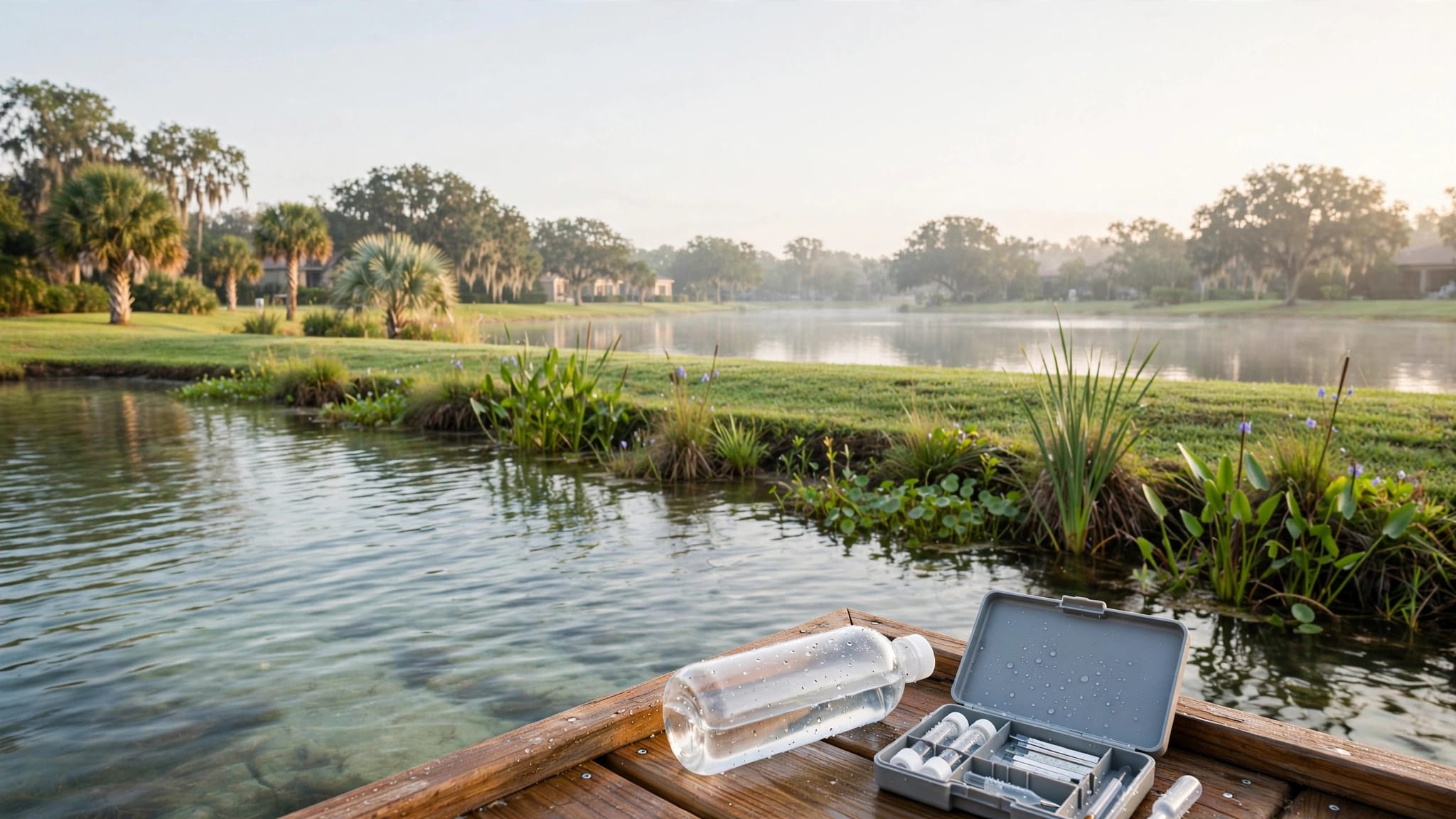
If the bank is stable and conditions are safe, a long-handled pond rake can bring up a small sample. Place the sample in a sealed bag or clear container, and keep it out of the water after inspection. Never throw unwanted fragments back into the lake.
Record the following details:
- Photograph the full stem, leaf whorls, and the top growth.
- Take a close image of the leaflets from both sides.
- Note the water depth and the approximate size of the affected area.
- Mark the location on a property map or phone map.
- Record whether the growth appears near an outfall, irrigation intake, fountain, or aerator.
Clear photos should show the plant beside a ruler or another familiar object. A lake manager can then compare the sample with established identification references or send it to an aquatic plant professional.
Avoid using a string trimmer, boat propeller, or mechanical rake without a removal plan. Fragmenting the plant can distribute viable pieces around the pond. Also, don't treat a large area based on one unconfirmed photograph.
What to Do After Confirming the Plant
Once the plant is identified, the next step is a lake inspection rather than an immediate blanket treatment. The service provider should assess plant density, water depth, access points, nearby desirable vegetation, fish activity, irrigation use, and the location of drainage structures.
Treatment choices depend on the plant and the lake's use. Aquatic herbicides must follow the product label, including instructions about dosage, treated acreage, water use, fish, irrigation, and any required posting period. A licensed applicator can select a method that matches the site instead of treating every visible plant with the same product.
Large infestations may need treatment in manageable sections. As vegetation dies and decomposes, dissolved oxygen can fall, especially in warm water. Treating too much dense growth at once can increase stress on fish and create more floating debris.
The timing of follow-up matters because surviving roots and new fragments can produce another flush of growth. Why lake weed treatments fail includes problems such as incorrect plant identification, dense mature growth, poor timing, and incomplete follow-up.
For a community property, the management plan should also explain resident communication. Board members may need to post treatment notices, protect irrigation intakes, keep residents and pets away during the label's restricted period, and document the treated area.
Seabreeze Lake Maintenance holds Commercial Applicator License #CM28291 and State-Licensed Specialty Contractor #SCC131152136. A licensed lake maintenance company can help confirm the plant and build a treatment plan for retention ponds, golf course lakes, and multi-lake communities.
Keep Eurasian Watermilfoil From Returning Unnoticed
No single treatment replaces regular inspections. A maintenance crew should look for new submerged growth during routine visits, especially after heavy rain, storms, shoreline work, or equipment activity. Early patches are easier to map and manage than mature beds that cover an entire cove.
A written lake record can track the location, estimated coverage, treatment date, water conditions, and follow-up results. This information gives an HOA board a clearer maintenance history and helps the service provider recognize recurring problem areas.
Seasonal conditions also affect lake work. Rain can wash nutrients and soil into a retention pond, while dry-season water levels may expose shallow areas where rooted vegetation becomes easier to see. A Florida lake maintenance schedule can help communities plan inspections and routine care across wet and dry periods.
Aeration, shoreline management, debris removal, and nutrient control may support a healthier lake, but they don't replace plant identification. The first question should remain simple: what species is growing, and where is it spreading?
If your community needs a second look at a suspected patch, Get a Free Lake Health Assessment from Seabreeze Lake Maintenance to arrange a lake inspection.
Conclusion
Identifying Eurasian watermilfoil starts with the whole plant, especially its soft, feather-like leaves arranged in whorls around a flexible stem. Color and surface mats can raise suspicion, but they can't confirm the species by themselves.
For HOA lakes and Florida retention ponds, accurate identification prevents the wrong treatment and helps crews protect desirable vegetation, fish, drainage areas, and resident access. A small patch deserves prompt documentation because stem fragments can spread the plant before the next routine inspection.
Recent Posts