Florida Lake Water Hardness: What HOAs Should Know
A lake can look clean while its chemistry tells a different story. Water hardness affects how calcium, magnesium, alkalinity, treatments, and aquatic life interact inside a community lake.
Florida lake water hardness is not a score for overall lake health. A hard lake can still have low oxygen, excess nutrients, algae, or shoreline problems. For HOA boards, property managers, and golf course teams, the useful question is how hardness fits with the rest of the water-quality picture.
What Florida lake water hardness tells HOA managers
Water hardness measures the amount of dissolved calcium and magnesium in the water. Laboratories usually report it as milligrams per liter, expressed as calcium carbonate, or mg/L as CaCO3. In freshwater, that number is close to parts per million.
These common ranges help place a test result in context:
| Hardness level | Approximate reading |
|---|---|
| Soft | 0 to 60 mg/L |
| Moderately hard | 61 to 120 mg/L |
| Hard | 121 to 180 mg/L |
| Very hard | Above 180 mg/L |
These ranges are reference categories, not Florida regulatory limits. A community lake doesn't need to reach a particular number simply because another lake has harder water.
Florida's geology explains much of the variation. Rainwater usually contains few dissolved minerals, while groundwater moving through limestone can pick up calcium and bicarbonate. A retention pond may receive both groundwater and stormwater, so two lakes within the same gated community can show different results.
Lake depth, evaporation, soil conditions, drainage patterns, and nearby irrigation can also affect the reading. A shallow pond that loses water during a dry season may become more concentrated. Heavy rain can dilute the water, while groundwater inflow can raise hardness again.
Hardness doesn't tell you whether water is safe for swimming, whether algae are present, or whether a lake meets every management requirement. It is one measurement within a larger testing program.
Why hardness matters in community retention ponds
Hardness affects water chemistry, but it isn't the same as alkalinity. Hardness measures calcium and magnesium. Alkalinity measures the water's ability to resist a drop in pH, with bicarbonate and carbonate providing much of that buffering in Florida waters.
The two readings often rise together when a lake receives limestone-influenced groundwater. They can still change independently. A lake may have moderate hardness but low alkalinity, or high hardness with enough alkalinity to keep pH changes smaller.
That difference matters when a lake experiences heavy rain, intense sunlight, or large amounts of decaying plant material. A stable pH supports more predictable conditions for fish and aquatic organisms. However, hardness alone doesn't create that stability.
Calcium and magnesium also affect how dissolved compounds interact with sediment and water. Calcium can bind with phosphorus under certain conditions, but the result depends on pH, oxygen, sediment chemistry, and the amount of phosphorus present. Hard water isn't a substitute for controlling fertilizer runoff or other nutrient sources.
Fish respond to changes in water chemistry, especially when conditions shift quickly. The ideal range also depends on the species present and the rest of the lake's chemistry. A sudden change after a major storm, drought, groundwater shift, or chemical application deserves a closer look.
Hardness doesn't cause green water by itself. Nutrient loading, warm temperatures, sunlight, water movement, and oxygen conditions usually play a larger role in algae growth. A rising chlorophyll-a result can appear before a visible bloom, so managers should review Florida HOA lake chlorophyll levels alongside hardness and other readings.
A lake can have hard water and still suffer from low oxygen or severe algae growth. Hardness is a chemistry reading, not a lake-health grade.
Which water-quality readings belong with hardness
A hardness result becomes more useful when you compare it with other measurements. For a retention pond or community lake, the most helpful companion readings often include:
- Alkalinity , which shows how well the water can resist pH changes.
- pH , which affects aquatic life, chemical behavior, and the toxicity of some compounds.
- Dissolved oxygen , which helps identify fish stress and poor circulation.
- Temperature , because warm water holds less oxygen than cooler water.
- Conductivity or total dissolved solids , which can reveal changes in the overall mineral load.
- Nitrogen, phosphorus, and chlorophyll-a , which help identify nutrient pressure and algae activity.
Salinity deserves separate attention in coastal Southwest Florida. Saltwater influence, irrigation water, or other sources can raise conductivity and chloride without giving managers a complete explanation through hardness alone.
Water clarity also needs a separate evaluation. Cloudy water may result from suspended soil, algae, organic debris, or bottom disturbance. A hard-water reading won't identify which cause is present.
The same applies to fountains and aeration systems. Aeration can improve circulation and dissolved oxygen, but it doesn't remove calcium, magnesium, or nutrients. Harder water can also contribute to mineral deposits on fountain nozzles, pumps, and other equipment when conditions favor scale formation. Regular inspections help catch buildup before it affects operation.
How to test hardness across multiple HOA lakes
One sample can't describe an entire multi-lake property. Each lake has its own drainage area, depth, shoreline vegetation, groundwater connection, and maintenance history.
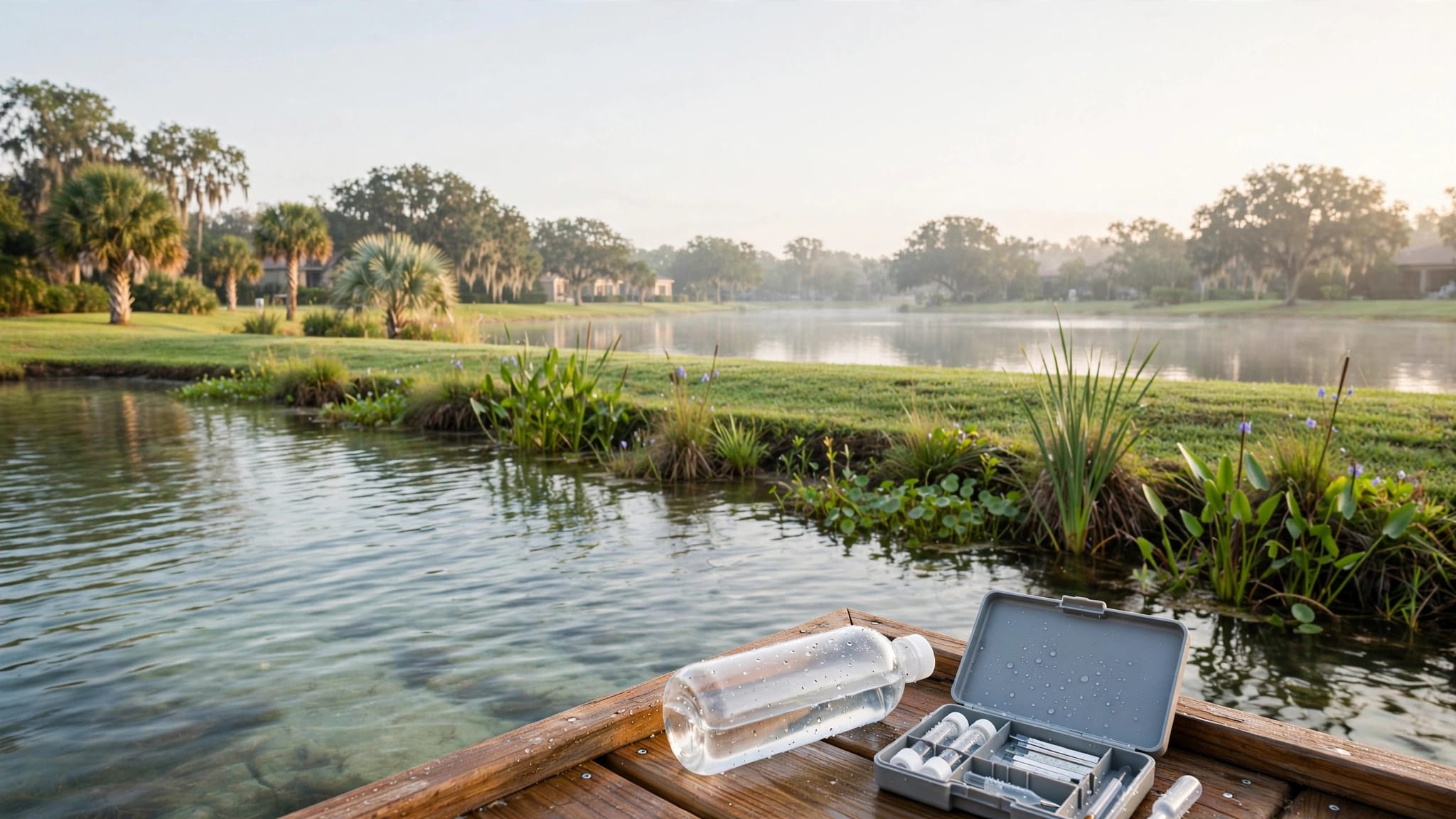
Start by creating a baseline for every lake. Collect samples at consistent locations and record the date, weather, recent rainfall, water level, visible algae, water color, and any recent treatment. Sample away from the shoreline and avoid collecting only surface scum or floating debris.
A practical sampling process includes these steps:
- Map each lake and sampling point. Use the same locations during future tests so results can be compared.
- Collect representative water samples. Follow the laboratory's container and handling instructions, and avoid contamination from hands, soil, or treatment equipment.
- Request a broader water-quality panel. Pair hardness with alkalinity, pH, dissolved oxygen, conductivity, nutrients, and chlorophyll-a when conditions call for a full review.
- Compare results over time. Look for changes after heavy rainfall, long dry periods, water-level changes, construction, or treatment applications.
A test taken after a major weather event may answer a different question than a routine baseline sample. Therefore, document what happened before interpreting the result.
Property managers can also use a consistent Florida HOA lake inspection checklist to record surface conditions, shoreline changes, algae, weeds, odors, debris, and erosion. Field observations often explain why a laboratory result changed.
There is no universal testing schedule for every Florida lake. A property with recurring algae, fish stress, drainage issues, or fluctuating water levels may need more frequent sampling. Stable lakes may need less frequent laboratory testing, supported by regular visual inspections.
What changes hardness in a Florida retention pond
Hardness usually changes when the water source or concentration changes. During drought, evaporation removes water but leaves most dissolved minerals behind. The result can be a higher hardness reading, especially in shallow lakes.
Heavy rainfall can have the opposite effect by adding relatively low-mineral water. Stormwater can also carry dissolved minerals and soil particles into the lake, so a rain event doesn't always lower the final reading.
Groundwater is another major factor. A lake connected to a shallow aquifer may receive water with a different calcium and magnesium content than a pond fed mainly by storm drains. Irrigation return flow can also influence conductivity and mineral levels.
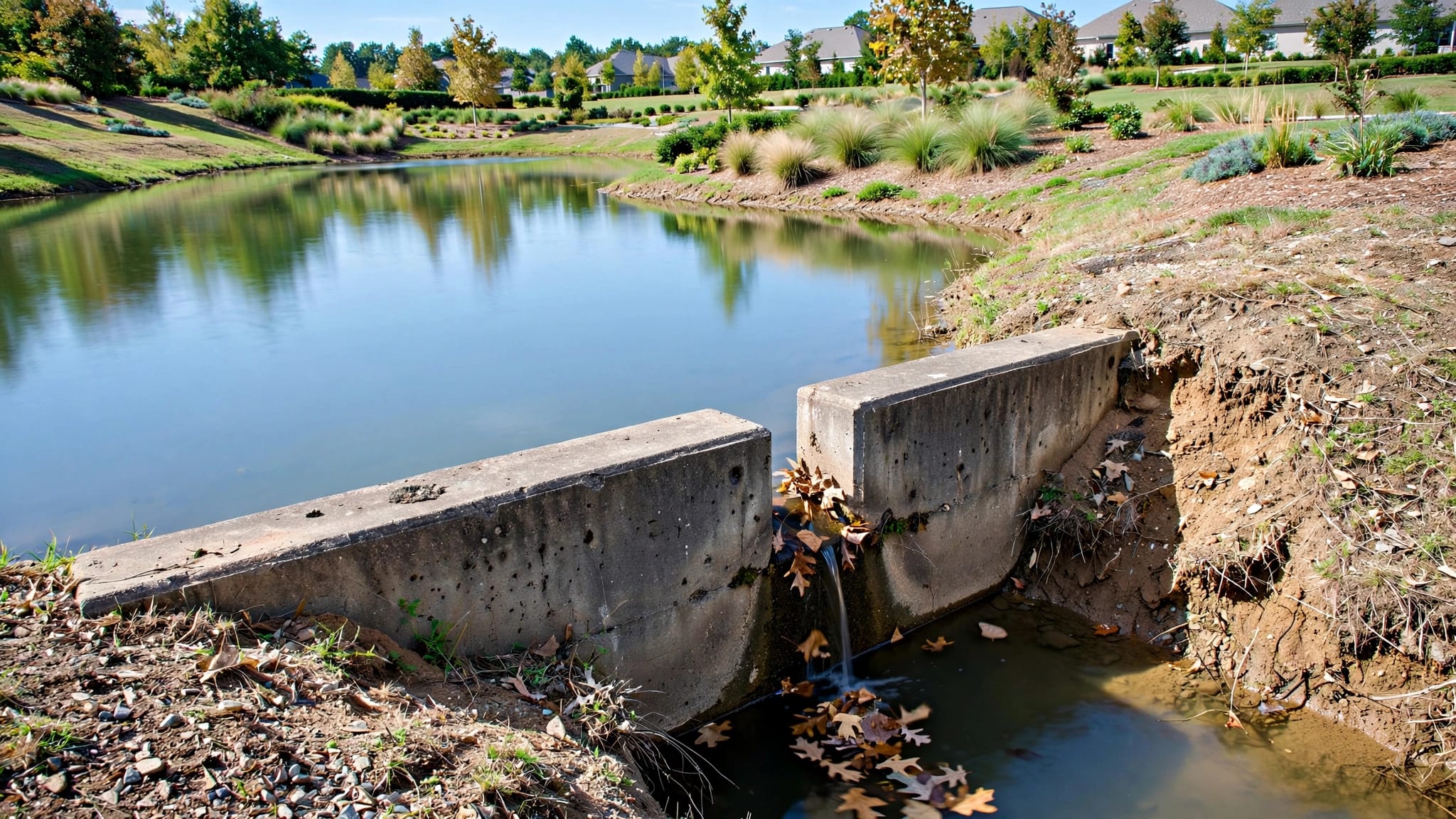
Construction, exposed soil, altered drainage, and shoreline work may change what enters the pond. In coastal areas, managers should also evaluate chloride and conductivity if saltwater influence is possible. Hardness alone can't diagnose salinity.
Products that contain calcium or alter alkalinity can change the water's chemistry. Managers should never add lime, gypsum, or another amendment based on hardness alone. A treatment plan needs current testing, a clear purpose, and consideration of the product label and site conditions.
Turning a hardness result into a maintenance plan
The best response to a hardness reading is usually careful comparison, not an automatic correction. First, ask whether the number differs from the lake's established baseline. Next, review rainfall, water levels, groundwater conditions, recent treatments, and nearby drainage changes.
Pair the result with the problem the community is seeing. If residents report green water, review nutrients, chlorophyll-a, water movement, and oxygen. For information about the nutrient side of that problem, see what high phosphorus in Florida lakes can mean for algae and water quality.
If equipment shows scale, inspect fountain heads, pumps, and diffuser components. If fish appear stressed, check dissolved oxygen, temperature, pH, and possible contaminants instead of blaming hardness. When shoreline erosion or runoff is present, address the source so the lake doesn't keep receiving sediment and nutrients.
Treatment choices should match the measured problem. Aquatic herbicide and algae-control applications require accurate identification, proper dosing, weather awareness, and compliance with the product label. Aeration, shoreline repairs, debris removal, and nutrient controls each address different conditions.
Seabreeze Lake Maintenance works with HOAs, gated communities, golf courses, apartment complexes, and commercial properties across Southwest Florida. The company holds Commercial Applicator License #CM28291 and State-Licensed Specialty Contractor #SCC131152136. Communities can Get a Free Lake Health Assessment to arrange a lake inspection and discuss ongoing maintenance needs.
Conclusion
Florida lake water hardness helps explain how a retention pond's chemistry behaves, but it can't tell the whole story. Calcium and magnesium levels should be reviewed with alkalinity, pH, dissolved oxygen, nutrients, conductivity, and field observations.
For an HOA or golf course, the most useful number is often the change from the lake's own baseline. Regular testing and consistent inspections make it easier to separate mineral changes from algae, oxygen, runoff, or shoreline problems. A hard-water lake can still be healthy, while a lake with moderate hardness can need immediate attention.
Recent Posts