Water Pennywort Identification for Florida Lakes
A small floating plant can cover a community shoreline before anyone agrees on what it is. Accurate water pennywort identification helps HOA boards, golf course managers, and property teams choose the right response for retention ponds and community lakes.
Water pennywort can resemble dollarweed, other pennywort species, or harmless shoreline plants. Look at the leaf attachment, stem growth, roots, and location before approving treatment. This guide covers the field signs that help Florida properties report a suspected infestation accurately.
What Water Pennywort Looks Like in a Florida Lake
Water pennywort is a creeping aquatic plant in the Hydrocotyle group. It can grow along shallow shorelines, across wet soil, or on the water surface. The plant often forms loose mats that move with wind and water movement.
The most recognizable feature is the round or kidney-shaped leaf . Many leaves have shallow, scalloped edges and a small notch where the stem joins the leaf. Depending on the species and growing conditions, the leaf may float flat on the surface or rise above the water.
Check the point where the stem meets the leaf. In pennywort, the stem often connects near the center or underside of the leaf rather than at the outer edge. This detail helps separate it from many ordinary shoreline weeds.
Long, thin stems spread horizontally across mud, shallow water, or saturated turf. New roots can develop at the stem joints, called nodes. Those rooted nodes allow a small piece of plant material to establish in another location.
The flowers are easy to miss. They may appear as tiny white or greenish flowers in small clusters on upright stalks. Flowering can help with identification, but a property manager shouldn't wait for blooms before reporting a fast-spreading patch.
Common names can create confusion. Florida properties may use "water pennywort," "pennywort," "dollarweed," or "lawn pennywort" for plants that look similar. A confirmed species identification is more reliable than a common name alone.
Water Pennywort Identification: Five Field Signs to Check
A close inspection can provide useful information before a lake maintenance professional arrives. Avoid walking into unstable banks or pulling plants from the water. Instead, photograph the patch and record what you see.
- Leaf shape and edge : Look for rounded or kidney-shaped leaves with scalloped margins. Young leaves may be smaller and less defined than mature leaves.
- Stem attachment : Check whether the stem joins near the center or underside of the leaf. A stem that connects to the leaf edge points toward a different type of plant.
- Creeping growth : Trace the stem along the water or shoreline. Pennywort typically spreads with runners that cross wet ground or float between rooted points.
- Roots at nodes : Where the stem touches mud or shallow water, look for fine roots. These roots can anchor the plant and help it spread along the edge.
- Growth position : Note whether the plant is floating, rooted in shallow water, or growing through saturated soil. Water pennywort can shift between these forms as water levels change.
Take photos from above and from the side. Include one image that shows the entire patch, one close-up of a leaf, and one image of the stem and roots. Also record the date, location, approximate area, and whether the patch sits near an inlet, outfall, drain, or aerator.
A single leaf may suggest pennywort, but the stem, node, and growth pattern provide stronger evidence.
Identification becomes harder when the plant grows through grass or mixes with desirable littoral vegetation. In that setting, a professional may need to inspect several sections before choosing a treatment area.
Plants That Look Like Water Pennywort
Florida community lakes contain many plants with overlapping shapes. Misidentification can waste treatment money and damage beneficial vegetation, so compare the structure rather than relying on color.
Dollarweed is one of the closest visual matches. Its rounded leaves often look like small coins, and it can grow in wet turf around pond edges. Since dollarweed and pennywort names may refer to related Hydrocotyle plants, the difference isn't always obvious from one photograph. Growth habit and species-level review matter.
Hydrilla has narrow leaves arranged around the stem. It may form dense underwater growth, but it doesn't produce the broad, round pennywort leaf.
Water hyacinth floats with swollen, bulb-like leaf stalks and thicker leaves. Its lavender flowers are also much more noticeable when present.
Duckweed consists of tiny floating leaf bodies, often only a fraction of an inch wide. It doesn't have the long creeping stems and larger rooted nodes associated with pennywort.
Algae may form green mats that look plant-like from a distance. Algae has no true leaves, stems, or roots. A close-up usually reveals a stringy, slimy, or granular texture instead of distinct leaf structures.
Alligatorweed can spread along shorelines and floating mats, but its leaves are elongated and arranged along the stem. They don't have the round, coin-like form of pennywort.
The location also provides clues. A patch growing in wet grass above the normal waterline may be a terrestrial or emergent Hydrocotyle species. A floating mat connected to runners in shallow water points toward an aquatic growth form. Neither setting alone confirms the species.
If the plant has already formed a dense mat, review why mature aquatic weeds resist lake treatments before scheduling a broad application. Established roots and incomplete coverage can lead to regrowth.
Why Pennywort Matters in Retention Ponds and Community Lakes
A few leaves near a shoreline may look harmless, but pennywort can interfere with daily lake management. Dense growth can hide the water's edge, cover drainage features, and make inspections more difficult.
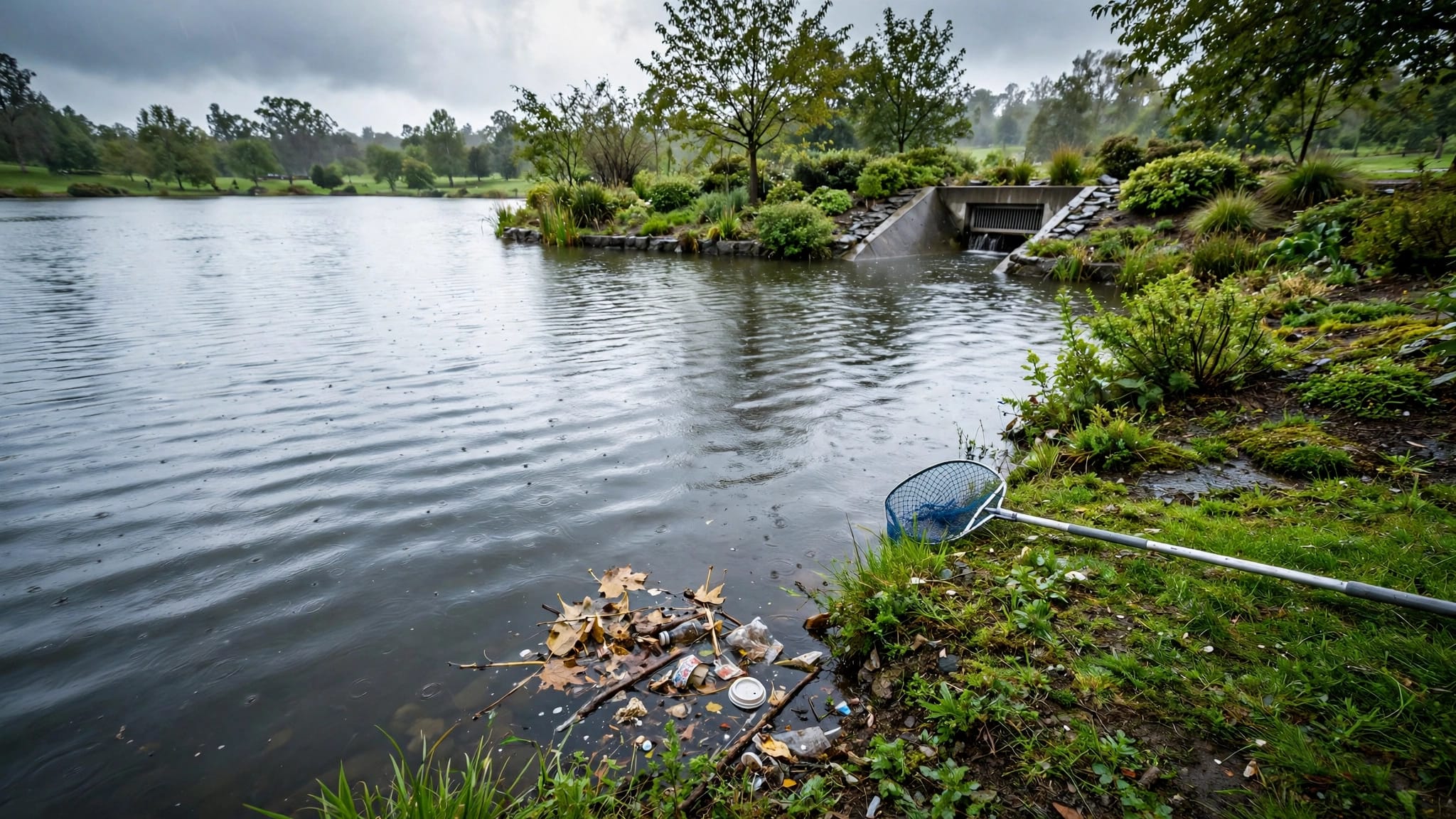
Retention ponds also depend on clear flow paths. Growth around inlets, outlet structures, and narrow connections can trap debris and reduce visual access. The plant itself may not block every structure, but any dense floating vegetation deserves attention near stormwater components.
Pennywort can also affect curb appeal. In a gated community or apartment property, residents and guests see the shoreline from roads, sidewalks, pool areas, and common spaces. Unchecked mats can make a maintained property look neglected.
Connected lakes create another concern. Water movement, mowing activity, wildlife, boats, and maintenance equipment can move plant fragments between basins. A patch near an inlet may spread into another lake after rain or a high-water event. Properties with multiple connected ponds should map each inlet and outlet, not inspect only the lake where residents first noticed the plant.
Read about managing weeds in connected community lakes when a property has several linked basins. A treatment plan should account for water routes and likely reintroduction points.
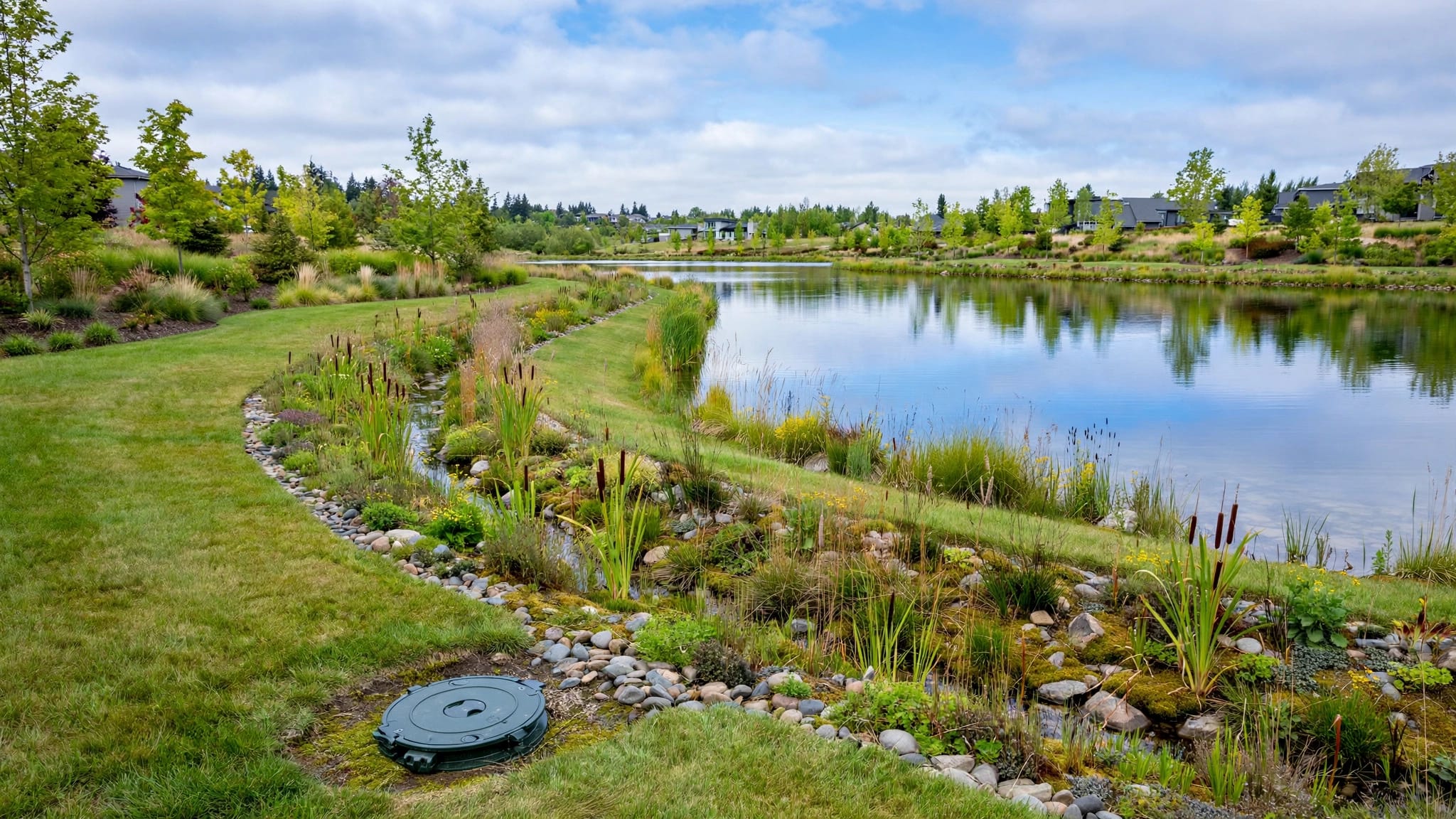
Water pennywort also competes with desirable shoreline plants when both occupy the same shallow zone. Removing everything along the edge can create bare soil, which may increase erosion and leave space for another weed. Selective control protects the intended littoral planting while reducing the unwanted growth.
What to Do After You Spot a Suspected Patch
Start by documenting the location instead of disturbing the plant. Mark the shoreline section on a property map and note whether the growth is floating, rooted, or spreading through wet turf.
Then collect clear photographs. A maintenance provider can often narrow the identification from images, but an on-site inspection gives better information about plant density, water depth, flow, and nearby vegetation.
Avoid throwing pulled fragments onto the bank. Pennywort stems can root at nodes, so discarded material may create another patch after rain. Bag plant material only when a professional directs you to do so, and keep fragments away from drains and connected water.
A practical inspection should include:
- Shoreline corners and coves where wind pushes floating vegetation
- Inlets, outfalls, culverts, and low-flow areas
- Areas below storm drains and turf runoff points
- Previously treated sections with visible regrowth
- Adjacent lakes connected by pipes, swales, or overflow routes
Treatment depends on the confirmed plant, its growth stage, the size of the infestation, nearby desirable plants, and the lake's use. A licensed aquatic applicator can select a labeled treatment and apply it to a manageable zone. The work should also account for water-use restrictions, residents, pets, wildlife, and any posted notices required for the product.
Mechanical removal may help with isolated material or debris-heavy areas, but removing the visible leaves doesn't always remove rooted runners. Follow-up inspections matter because small fragments and missed nodes can produce new growth.
A broader program may combine plant identification, selective aquatic weed treatment, shoreline maintenance, debris removal, water-quality checks, and regular monitoring. Integrated aquatic weed and algae control can help properties address the plant and the conditions that support repeated growth.
When a Community Should Call a Lake Maintenance Professional
An HOA board or golf course team should request an inspection when pennywort covers a growing section of shoreline, reaches an inlet or outfall, returns after treatment, or mixes with desirable littoral plants.
Professional help is also appropriate when the plant's identity remains uncertain. Water pennywort identification guides are useful for screening, but they can't replace an on-site review when a treatment decision affects a large lake or a regulated stormwater system.
Seabreeze Lake Maintenance works with HOA communities, gated neighborhoods, golf courses, apartment complexes, and commercial properties in Southwest Florida. The company provides aquatic weed and algae control, water-quality management, shoreline inspections, debris removal, aeration, erosion control, and ongoing weekly or biweekly maintenance.
Seabreeze Lake Maintenance holds Commercial Applicator License #CM28291 and State-Licensed Specialty Contractor #SCC131152136 . These credentials support responsible lake work for retention ponds and community lakes, rather than ornamental koi ponds.
For a suspected pennywort patch, Get a Free Lake Health Assessment and arrange a lake inspection. Early identification gives the property team more options before growth reaches connected basins or drainage structures.
Conclusion
Reliable water pennywort identification starts with the whole plant. Check the rounded leaf, central or underside stem attachment, creeping runners, rooted nodes, and growth location before calling it pennywort.
For Florida retention ponds and community lakes, early reporting protects shoreline access, drainage inspections, curb appeal, and desirable vegetation. A clear photo helps, but a professional site review provides the information needed for safe, selective control. When the first small patch appears, accurate identification is often the difference between a focused maintenance visit and a larger lake-wide problem.
Recent Posts