How to cut energy use in Florida HOA lake aeration systems
High electric bills often make community boards question whether their HOA lake aeration system needs to run all day and night. In many cases, the savings come from better sizing, smarter schedules, and cleaner equipment, not from shutting the system off without checking water quality.
Retention ponds and lakes in gated communities, golf courses, and multi-lake properties have different depths, shapes, and oxygen demands. These water features aren't koi ponds, and a schedule that works for one basin may leave another lake short on circulation. Start with dissolved oxygen readings, then adjust the equipment and runtime to match the actual lake.
Measure dissolved oxygen before changing runtime
Aeration should protect water quality while using only the energy the lake needs. Dissolved oxygen testing gives a board or property manager a reliable basis for changing the schedule.
Build an oxygen profile for each lake
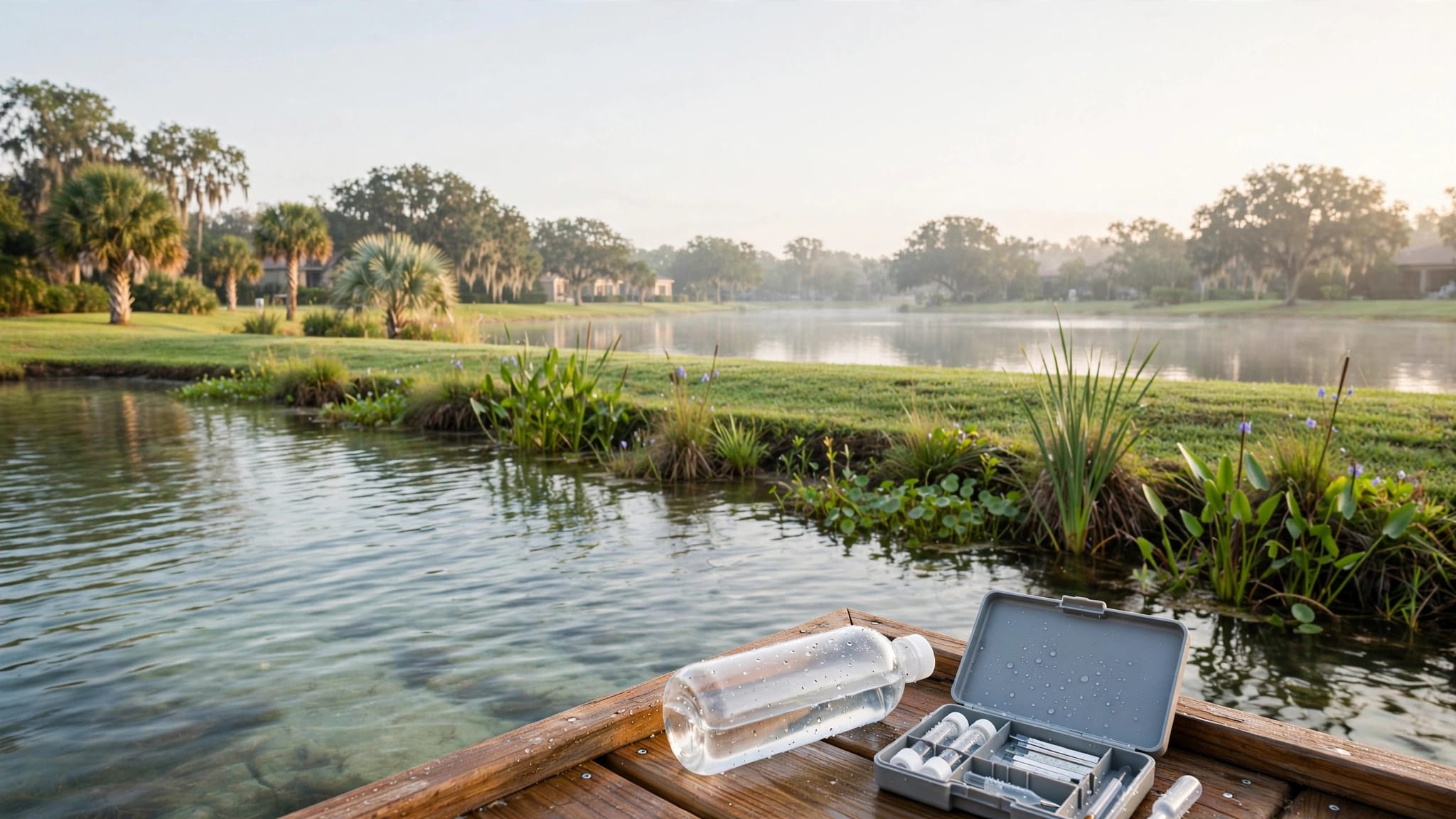
A surface reading doesn't show what happens near the bottom. Test at several depths and locations, especially in the deepest basin, near coves, and in areas with little wind-driven circulation.
UF/IFAS guidance identifies approximately 5 milligrams per liter or higher as a healthy dissolved oxygen level for fish. Fish stress becomes more likely around 2 to 4 milligrams per liter, while levels below 2 can lead to mortality.
Florida's warm water holds less oxygen than cool water. Therefore, readings taken in the late afternoon and again during the late evening can show whether oxygen is falling before sunrise. Property managers can review dissolved oxygen monitoring for community lakes before reducing aeration hours.
Focus operation on high-risk periods
Warm, calm nights create greater oxygen risk because photosynthesis stops after dark while fish, plants, and microorganisms continue using oxygen. A lake that has stable readings may need less daytime operation, while a deep or nutrient-rich basin may need longer nighttime circulation.
UF/IFAS recommends focusing aeration during the late evening and early morning, when oxygen levels often reach their lowest point. Running a large system through the middle of a sunny afternoon can waste power when the lake already has higher oxygen levels.
Don't apply one schedule across every lake in a community. Track oxygen readings, weather, algae activity, water color, odor, and fish behavior for each basin.
Right-size compressors for depth and airflow
An oversized compressor can consume unnecessary electricity. An undersized system can run longer without properly mixing the lake. Both problems increase operating costs.
Calculate pressure, airflow, and line losses
Compressor selection should begin with operating depth and required airflow, not motor horsepower alone. Water pressure increases by about 0.433 psi per foot of depth . At 12 feet, the diffuser already needs to overcome roughly 5.2 psi before accounting for airline length, valves, fittings, and diffuser resistance.
The compressor must deliver its rated airflow at the system's actual operating pressure. A unit that produces a high CFM rating at low pressure may deliver much less air at the bottom of a deep retention lake.
Line length matters as well. Long airline runs can add friction loss, particularly when the line is undersized or partially blocked. Choose equipment for continuous-duty operation when the system will run for many hours each day.
Some lake management designs use a target of at least one complete water turnover per day, but the correct target depends on lake volume, depth, shape, nutrients, and oxygen demand. A professional assessment can prevent the board from paying for more compressor capacity than the basin requires.
Use zones on multi-lake properties
A community with several lakes doesn't always need every diffuser zone running at full output. Independent zones allow the operator to adjust circulation for different depths, problem areas, and seasonal conditions.
For example, a deep central basin may need consistent bottom diffusion, while a shallow perimeter section may need less runtime. Separate manifolds can also help isolate a repair without taking the entire property offline.
The choice between surface equipment and bottom diffusers affects energy use and coverage. Review Florida lake aeration system options alongside depth and basin measurements before replacing equipment.
Use HOA lake aeration controls to cut runtime
Timers, zone controls, and staged startup can lower power use without leaving the lake unmanaged. However, controls should follow water-quality data rather than replace it.
Schedule operation for nighttime demand
A timer can run the compressor during the hours when dissolved oxygen is most likely to decline. Many Florida lakes benefit from a late-evening through early-morning schedule, especially during hot, windless weather.
Seasonal programming is more useful than a permanent 24-hour setting. The system may need longer operation during the hottest part of summer, after heavy organic loading, or when algae growth increases oxygen demand. During cooler or more stable periods, testing may support a shorter schedule.
After a long outage or installation in a stagnant lake, start gradually. Running full output immediately can move oxygen-poor bottom water too quickly and stress fish. A staged increase over several days gives the lake time to adjust while the service provider watches oxygen levels and water conditions.
Consider variable-speed control carefully
A variable frequency drive can reduce power use when the compressor and motor are designed to operate safely at reduced speed. It isn't a universal add-on. Lowering speed too far may reduce pressure or airflow below what the diffusers need.
Ask the aeration contractor and equipment manufacturer whether variable-speed operation is approved for the specific compressor. In many communities, a properly programmed timer and independent zone controls provide a more practical savings measure than adding a VFD to incompatible equipment.
The best control plan combines measured oxygen levels, nighttime scheduling, zone adjustment, and a backup response for heat waves or sudden fish stress.
Maintain equipment so it doesn't work harder
A dirty diffuser or leaking airline can raise system pressure and reduce delivered airflow. The compressor then works harder, or the operator leaves it running longer to compensate.
Inspect compressor pressure, airflow, manifolds, valves, airline connections, electrical components, and diffuser output on a regular schedule. A sudden pressure increase can point to a clogged diffuser, damaged line, closed valve, or other restriction. A sudden pressure drop may indicate a leak.
Keep compressor intakes clear and follow the manufacturer's service instructions. Check the system after storms, landscaping work, and any electrical interruption. Routine inspections also help identify broken fountain patterns, damaged cabinets, and vegetation or debris that blocks access.
Aeration alone doesn't remove the nutrients that feed algae. Fertilizer runoff, decaying vegetation, sediment, and shoreline erosion can increase oxygen demand. Pair equipment maintenance with responsible aquatic treatments, debris removal, inlet and outlet checks, and shoreline care. Communities can also use a Florida HOA lake inspection checklist to keep service records consistent across multiple basins.
For a professional review, Seabreeze Lake Maintenance serves Southwest Florida communities, golf courses, and other multi-lake properties. The company holds Commercial Applicator License #CM28291 and State-Licensed Specialty Contractor #SCC131152136. Boards can Get a Free Lake Health Assessment to review aeration performance, oxygen conditions, and maintenance needs.
Conclusion
Lowering aeration costs starts with knowing what each lake requires. Test dissolved oxygen, size compressors by operating pressure and airflow, use zones where possible, and schedule runtime around Florida's nighttime oxygen demand.
Clean diffusers and sound airlines also matter because restricted airflow wastes electricity. With regular measurements and professional maintenance, HOA lake aeration can support healthy retention ponds and attractive community lakes without running unnecessary equipment hours.
Recent Posts