How to Document Aquatic Herbicide Applications for Florida HOAs
A retention pond can look clean on Monday and show floating weeds or algae by Friday. For HOA managers, the treatment itself is only part of the job. Aquatic herbicide applications also need clear records that show what happened, where it happened, and whether the work followed Florida requirements.
This process applies to retention ponds and lakes in gated communities, golf courses, and other multi-lake properties. It does not apply to koi ponds. A well-organized file protects the association, helps future boards understand treatment history, and gives residents accurate answers when they ask about lake maintenance.
Why Florida HOA Lake Records Matter
A treatment log is more than a receipt. It creates a running history of the lake's condition and shows how the maintenance team responded to aquatic weeds, algae, or other vegetation.
HOA boards change members regularly. Without detailed records, a new board may not know which pond received treatment, which product worked, or whether a recurring algae problem started after a storm, fertilizer runoff, or low circulation. Good documentation prevents each board from starting over.
The file should answer four basic questions:
- What waterbody and treatment area received service?
- Which target plant or algae problem required attention?
- Which licensed applicator used which product and amount?
- What permits, notices, label restrictions, and follow-up steps applied?
Keep the compliance layers together
Florida lake treatment records involve more than one authority. The Florida Department of Agriculture and Consumer Services, or FDACS, regulates pesticide applicator licensing and pesticide use under Chapter 487. The Florida Fish and Wildlife Conservation Commission, or FWC, regulates aquatic plant management in waters of the state under Section 369.20 and Chapter 68F-20.
The product label adds another layer. Only an herbicide registered and labeled for direct application to water should be used in a Florida lake or retention pond. The label controls application rates, target species, personal protective equipment, water-use restrictions, posting instructions, and reentry directions.
Give the board useful history
Save the treatment report with photos, water-quality results, inspection notes, and resident notices. This record helps the board compare conditions over time instead of judging the lake from one visit.
For example, a report can show that Lake 2 had repeated hydrilla growth, low dissolved oxygen, and heavy stormwater inflow. That information may support changes to aeration, nutrient management, shoreline care, or treatment timing.
Start With the Waterbody and Treatment Area
A report that says "community pond" is too vague for a property with six lakes. Assign every waterbody a consistent name or number before scheduling work.
Assign durable lake IDs
Record the HOA's legal name, property address, and the name or number of the lake. Include the approximate surface acreage, a site map, and the areas included in the treatment.
Useful identifiers include:
- Lake 1, west retention pond
- Lake 3, clubhouse pond
- North canal, inlet zone
- Lake 5, preserve shoreline
Mark treatment zones on a map when the applicator treats only part of a lake. A map can show open water, littoral plant areas, stormwater inlets, outfalls, fountains, aerators, docks, and access points.
A board-approved naming system prevents confusion when vendors, managers, and residents use different names for the same waterbody. Property managers can also use this Florida HOA lake inspection checklist to organize recurring observations across multiple ponds.
Record conditions before treatment
The pre-treatment section should describe what the applicator saw before work began. Include the date and time of inspection, target species, estimated coverage, water level, water color, odor, visible algae, debris, and shoreline conditions.
Add notes about recent rainfall, stormwater flow, irrigation discharge, or unusual water movement. Record whether the treatment area is near a potable-water intake, irrigation intake, fish habitat, wetland connection, or public access point.
Photos are valuable when they come from consistent locations. Use the same shoreline viewpoints when possible, then label each image with the lake ID, direction, date, and time. Before-and-after photos are much easier to compare when the camera position stays similar.
Build the Application File Before Treatment
The application record should begin before the product reaches the water. A pre-treatment file reduces missing information and gives the HOA a chance to review access, notice, and scheduling needs.
Identify the applicator and credentials
Record the applicator company's legal name, business address, applicator's full name, and FDACS license number. Confirm that the license covers the work being performed and retain the license information with the service report.
For Seabreeze Lake Maintenance, the company credentials include Commercial Applicator License #CM28291 and State-Licensed Specialty Contractor #SCC131152136 . The treatment file should still identify the individual applicator and the license information tied to the pesticide work.
Also list the HOA or property manager as the customer. A complete customer entry includes the association's legal name, property address, manager's name, and a contact person who approved the service.
Confirm the product and label
Record the product's trade name, manufacturer, EPA registration number, active ingredient, formulation, and label rate. The file should identify the target species and confirm that the product is labeled for the planned aquatic use.
Florida aquatic-management references include products such as Alligare Diquat Herbicide, ProcellaCOR SC, Tradewind, Stingray, Komeen, and other copper-based formulations. These names are examples, not a treatment recommendation. The report must name the product actually used.
Keep a copy of the current label with the job file. Record label restrictions that affect irrigation, swimming, fishing, livestock, pets, water intake, residents, or wildlife. If the label requires a waiting period or public notice, include that information in the schedule and completion report.
Record Exactly What Happened on the Service Date
The final report should allow someone who was not present to reconstruct the application. Use the same form for every lake and every visit.
Capture the treatment details
These fields provide a practical application record:
| Record field | What to include |
|---|---|
| Property | HOA name, address, lake or pond ID |
| Applicator | Company, applicator name, FDACS license number |
| Timing | Application date, start time, stop time |
| Product | Trade name, manufacturer, EPA registration number, active ingredient |
| Treatment | Target species, treatment zones, rate, total amount used |
| Coverage | Estimated acres or surface area treated |
| Equipment | Boat, backpack sprayer, spray rig, injector, or other equipment |
| Mixing and loading | Location and any relevant handling notes |
| Weather | Wind speed, wind direction, temperature, rainfall, and unusual conditions |
| Authorization | FWC permit number or documented exemption basis |
| Notice | Posting method, location, date, and photographs |
| Follow-up | Access restrictions, observation date, and next recommendation |
Avoid vague entries such as "pond sprayed" or "weeds treated." Write "Lake 3, east cove and north shoreline, treated for hydrilla" when that is what occurred.
Preserve weather and equipment information
Wind and weather records help explain drift risk, treatment coverage, and unexpected results. Record average wind speed and direction when required by the product label or applicable recordkeeping rule. Add nozzle type, spray pressure, flow rate, and spray angle when those details apply to the equipment.
If the applicator treats more than 5 cumulative acres of land or water with an organo-auxin herbicide during a 24-hour period, Florida recordkeeping requirements include detailed information and a two-year retention period. Those records can include the owner or tenant, applicator, site and mixing area, equipment, application time, product details, rate, acreage, wind speed, wind direction, and spray settings.
The applicator should verify the current rule and label requirements for each job. Product class, application method, acreage, and label language can change what the file needs to contain.
Handle FWC Permits, Notices, and Access
Aquatic vegetation work can fall under both pesticide rules and aquatic plant management rules. Treating an HOA-owned lake does not automatically remove the need to check FWC requirements.
Document the permit or exemption basis
FWC states that anyone who wants to control or remove aquatic vegetation from waters of the state must obtain an Aquatic Plant Management Permit unless a statutory or rule-based exemption applies.
Some artificial or privately owned waterbodies may qualify for an exemption. Other sites can involve connected waters, public access, sensitive resources, or conditions that require additional review. The treatment file should state one of the following:
- The FWC permit number and approved treatment scope.
- The rule or statutory basis for the exemption.
- The date and name of the person who confirmed the permit status.
- Any restrictions attached to the permit or exemption.
An exemption from an FWC permit does not remove the need to follow the herbicide label or applicable public-notice requirements.
For questions about aquatic plant permitting, the FWC Invasive Plant Management Section lists a Tallahassee office and phone number, (850) 617-9430. Check the current FWC requirements before work begins, especially when a lake connects to another waterbody.
Record notices and reentry controls
For exempt waters, Florida's aquatic plant rules still include public notice requirements under Rule 68F-20.0055(2)(c), Florida Administrative Code. Keep a copy of the notice, the posting date, the locations used, and photographs showing the signs in place.
The product label controls reentry and water-use instructions. Florida does not provide one universal aquatic reentry period for every herbicide. Therefore, the report should identify the actual label direction used for the product and site.
Record who posted the signs and who removed them. Include temporary controls for docks, fishing areas, walking paths, irrigation intakes, boat access, and other community facilities. If a storm, vandalism, or maintenance work removes a sign, note the replacement date.
Close the File With Follow-Up Evidence
A treatment report is incomplete if it ends when the boat leaves the water. Follow-up information helps the HOA judge results and decide whether the lake needs another response.
Add a same-day completion report
After the application, record the actual areas treated, amount used, weather at completion, and any area left untreated. Note spills, equipment problems, damaged signs, resident access issues, or unusual water conditions.
The applicator should also document cleanup and disposal steps when they apply. If the crew found fish stress, a large algae die-off, a blocked inlet, or heavy floating debris, describe the observation and report it through the HOA's normal management process.
A clear report distinguishes planned work from completed work. If the crew planned to treat one acre but treated only half an acre because of wind or access, the final record should say so.
Track the lake after treatment
Schedule a follow-up inspection based on the product label, treatment purpose, and site conditions. Record whether the target vegetation declined, whether untreated areas expanded, and whether non-target plants or wildlife showed an unexpected response.
Take follow-up photos from the same locations used before treatment. Also note water color, odor, clarity, algae pressure, dissolved oxygen concerns, shoreline condition, and new stormwater inflow.
Herbicide control is one part of lake care. The report should state whether the application supported a broader integrated aquatic weed and algae control plan that includes inspection, mechanical removal, aeration, nutrient management, or shoreline work.
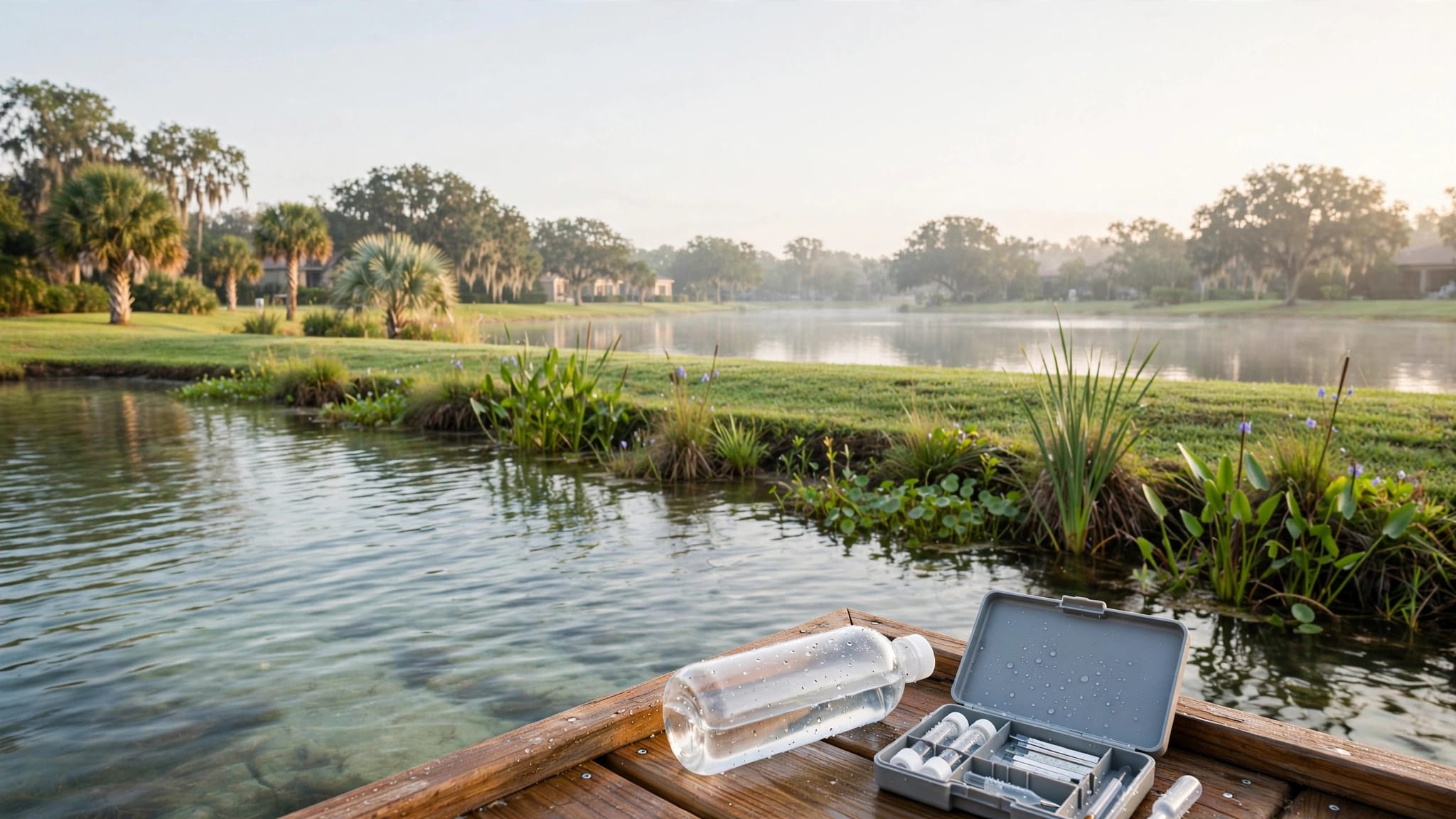
Water tests can add useful context when algae or low oxygen keeps returning. The HOA can compare treatment history with HOA lake water test results instead of judging success by appearance alone.
Store Records So the Board Can Use Them
Good records need a consistent storage system. Keep the application report, label, permit or exemption documentation, notice photos, maps, weather notes, invoices, and follow-up photos in one property file.
Use consistent digital folders
Create a folder for each property and a subfolder for each lake. Use filenames that include the date and waterbody ID, such as:
2026-08-21_Lake-3_Herbicide-Application_Report
Save the signed report as a PDF and preserve original photos. If the company uses a digital service platform, give the manager access to completed reports instead of relying on email attachments that can disappear when staff changes.
Retain documents for the period required by the product label, FDACS rules, FWC requirements, and the HOA's contract. When the two-year organo-auxin recordkeeping rule applies, the association and applicator should both preserve the required information for at least that period.
Put reporting terms in the service contract
The HOA's contract or RFP should require a written report after every treatment. Ask vendors to identify the product, active ingredient, EPA registration number, rate, amount, treatment area, applicator license, weather, notice method, permit or exemption basis, and follow-up plan.
The contract can also require fixed-point photos, updated lake maps, emergency reporting, and prompt notice of fish kills, spills, erosion, blocked structures, or unusual water conditions. Boards comparing vendors can use these HOA lake service proposal comparison tips to request the same information from every company.
A clear reporting standard makes proposals easier to compare and service history easier to audit.
Conclusion
Florida HOA records should show more than the date a pond was sprayed. They should connect the waterbody, target problem, licensed applicator, labeled product, treatment details, FWC status, public notice, access controls, and follow-up observations in one usable file.
For retention ponds and lakes in gated communities, accurate aquatic herbicide applications records protect residents, wildlife, property managers, and future board members. They also help the maintenance team treat recurring problems with better timing and fewer surprises.
If your community needs a documented lake inspection and treatment plan, Get a Free Lake Health Assessment from Seabreeze Lake Maintenance.
Recent Posts