What ORP Readings Mean in Florida HOA Lakes
A Florida community lake can look clean at the shoreline while water-quality conditions shift below the surface. ORP readings help show whether water is more oxidizing or reducing, but they aren't a stand-alone score for lake health.
For HOA boards, golf course managers, and property teams, the useful question isn't whether one number looks high or low. It's whether the result matches dissolved oxygen, pH, temperature, nutrients, water clarity, and field conditions.
That context matters in Florida retention ponds and lakes, where stormwater, aeration, and decaying vegetation can change chemistry quickly. Start with what the meter measures.
What ORP readings measure in a community lake
ORP stands for oxidation-reduction potential. A meter reports it in millivolts (mV), reflecting the water's tendency to accept or give up electrons.
The US EPA and Standard Methods describe ORP as an intensity measurement. It doesn't measure total oxidizing capacity, dissolved oxygen, or algae by itself. Instead, it provides a snapshot of the water's chemical condition at the time and place of sampling.
Positive and negative values
A positive reading points to more oxidizing conditions. Aerated surface water often has positive ORP, while oxygen-poor bottom water, saturated sediment, and decomposing plant material can shift toward reducing conditions.
A negative reading isn't an automatic violation, and a positive number isn't proof that a lake is healthy. Depth, chemistry, weather, circulation, and organic load all affect what the result means.
Why a single reading can mislead
Natural lake water rarely reaches the chemical equilibrium needed for a simple textbook interpretation. Standard Methods cautions that ORP can be difficult to connect to one process in an outdoor water body.
Surface water and bottom water may show different conditions during the same visit. ORP readings work best as part of a repeated record, not a pass-or-fail test.
Why Florida conditions change ORP readings
Florida's heat, strong sunlight, heavy rain, and fast-growing vegetation can move water chemistry during one day. Sampling methods must stay consistent if a board wants to compare results.
Florida has no universal lake ORP target
Florida Department of Environmental Protection stormwater guidance does not establish one universal ORP limit for HOA lakes or retention ponds. Its design and maintenance guidance focuses on treatment volume, hydraulic residence time, pond depth, drawdown, and pollutant removal.
A generic online range, such as 300 to 500 mV, shouldn't become a board policy or treatment trigger. Outdoor freshwater systems differ in oxygen demand, sediment, inflow, and circulation. Set a baseline for each lake instead, then watch for sustained changes beside other measurements.
What moves the number
Aeration and water movement often support more oxidizing conditions. Heavy organic loading, decaying algae, leaves, and low-oxygen sediment can pull the reading lower.
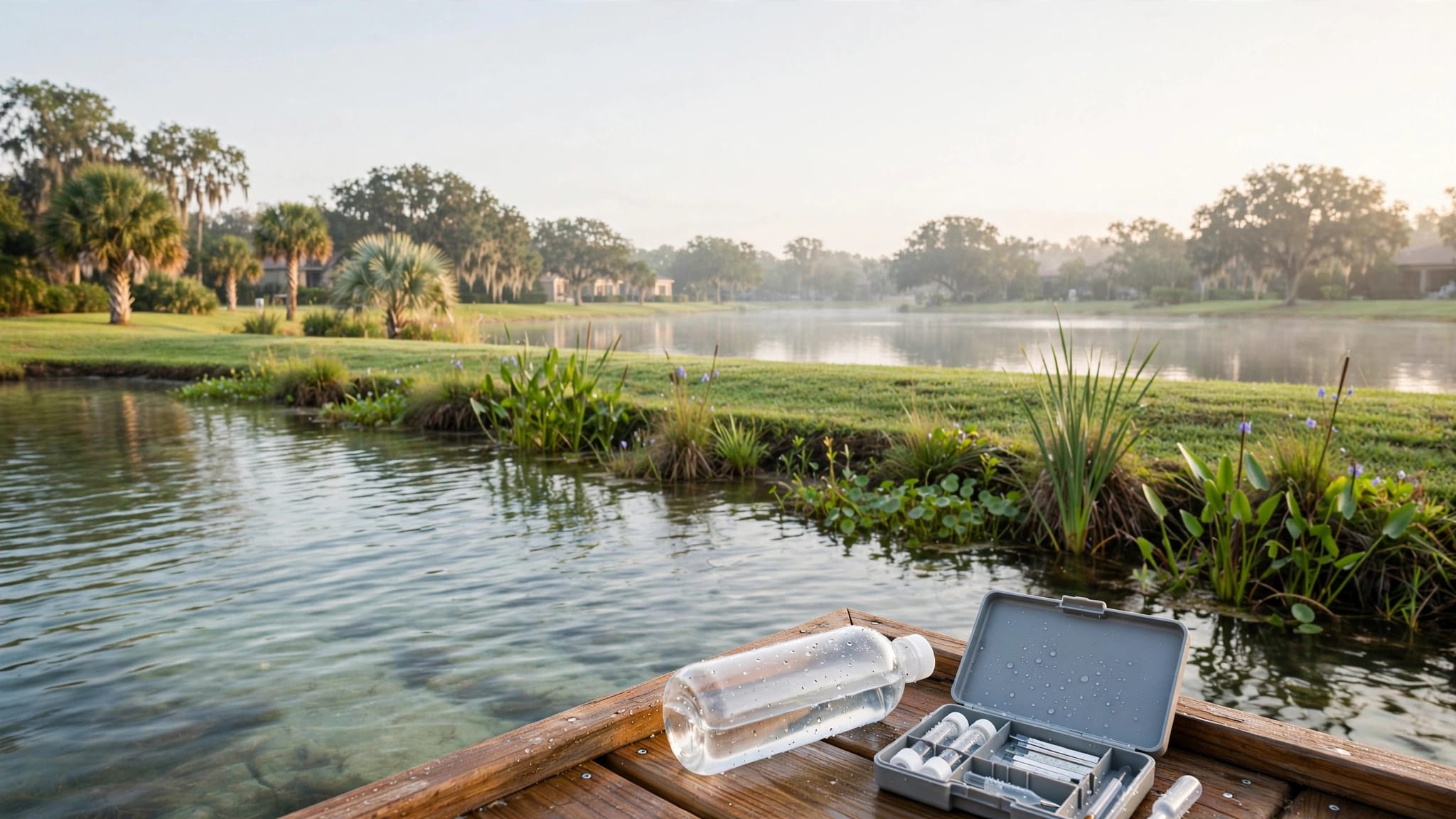
pH, temperature, conductivity, sunlight, and recent rainfall also affect results. The meter's reference electrode, calibration, and sample handling matter too. EPA field procedures use temperature-corrected calibration checks, including Zobell solution.
For reliable comparisons, sample the same general location and depth at a similar time. Record rain, aeration status, and unusual lake conditions with every test.
Which lake tests belong beside ORP
ORP readings become more useful when they sit beside the measurements that explain them. A lake test panel should match the property's risks and management goals.
Dissolved oxygen, pH, and temperature
Dissolved oxygen is the first companion test to review. If ORP falls while bottom-water DO also falls, the combination may point to weak circulation, high decomposition, or an oxygen-poor zone.
Measure DO at more than one depth when a lake has deep areas, heavy algae, fish stress, or signs of stratification. Record pH and temperature at the same time because both influence ORP and help explain daily changes.
Fish at the surface, foul odor, or recurring low-oxygen conditions deserve prompt attention. Review these low dissolved oxygen warning signs with the rest of the field observations.
Nutrients, clarity, and shoreline clues
Phosphorus and nitrogen can feed algae, while dying vegetation adds organic matter that increases oxygen demand. A high chlorophyll-a result may reveal active algae growth before the water looks bright green, so compare ORP with chlorophyll-a testing in community lakes.
Also record water clarity, color, turbidity, sediment buildup, shoreline erosion, inflow points, and debris. If phosphorus is elevated, investigate phosphorus and algae blooms, fertilizer runoff, irrigation overspray, and eroding banks instead of chasing the ORP number alone.
How HOA boards should use ORP results
An HOA board can use ORP as a trend marker and a reason to ask better questions, not as permission to order chemical treatment from one test.
Ask how the sample was collected
Before comparing two reports, confirm the sampling location, depth, date, time, weather, recent rain, and aeration status. Ask which instrument and reference electrode the technician used, when it was calibrated, and whether the report gives ORP as measured or converted Eh.
Those details prevent false comparisons. A surface sample beside a running fountain isn't equivalent to a bottom sample taken after several cloudy days.
Track trends before choosing a response
A pattern across visits matters. Falling ORP paired with low DO, odor, fish gasping at the surface, or repeated algae points toward a site review of circulation, organic buildup, nutrient sources, and sediment conditions.
The response may involve aeration adjustments, debris removal, shoreline corrections, nutrient control, or targeted algae management. The test result alone can't choose among them.
Monthly reports should show readings, locations, observations, and recommended follow-up. Boards can use these monthly lake service reports to compare recurring issues across a property's lakes.
For a professional assessment, Seabreeze Lake Maintenance holds Commercial Applicator License #CM28291 and State-Licensed Specialty Contractor #SCC131152136. Communities can Get a Free Lake Health Assessment before a small water-quality concern becomes a larger maintenance problem.
Conclusion
An ORP meter gives a useful view of whether conditions are more oxidizing or reducing, but it can't label a Florida HOA lake healthy or unhealthy on its own.
The strongest interpretation combines a consistent trend with DO, pH, temperature, nutrients, clarity, and site observations. A clear shoreline can hide changing conditions below it, so sound lake decisions start with the full water-quality picture.
Recent Posts