Florida Pondweed Identification for Community Lakes
A green patch can change a lake maintenance decision in one afternoon. Accurate Florida pondweed identification helps an HOA, golf course, or property manager tell the difference between a manageable native plant and a fast-spreading aquatic weed.
Pondweed can affect stormwater flow, pump intakes, shoreline views, and water quality. Yet treating the wrong plant can damage beneficial vegetation and waste money. Start with the plant's leaf arrangement, growth habit, and location before choosing a control method.
Why Pondweed Identification Matters in Community Lakes
"Pondweed" describes several aquatic plants, including species in the Potamogeton genus and closely related plants such as sago pondweed. These plants don't all respond to the same treatment. Some grow in thin underwater stands, while others produce broad floating leaves or dense growth near the surface.
A retention pond may support some aquatic vegetation without needing full removal. Native plants can provide habitat, reduce wave action, and help stabilize shallow edges. The problem starts when growth blocks a control structure, covers a large surface area, or spreads through connected lakes.
Identification also protects the lake's water quality. A heavy treatment can kill a large amount of vegetation at once. As the dead material decomposes, it can lower dissolved oxygen, especially in warm, poorly circulated water. Fish stress and odor may follow.
The plant's location matters as much as its name. Growth near an outfall deserves faster attention than a small underwater patch in a quiet cove. A few plants beside a pump intake can create a practical problem before the entire pond looks overgrown.
A clear shoreline doesn't prove that a weed problem is gone. Rooted plants can remain below the surface and return after the visible growth disappears.
Community lakes also have multiple users. Residents walk pets beside the water, golfers search for balls near hazards, and maintenance crews work around banks, drains, and aerators. A lake plan must account for visibility, access, wildlife, and label restrictions, not appearance alone.
Florida pondweed identification starts with leaf arrangement
The first step is to look at how the plant grows. True pondweeds usually have individual leaves arranged along a stem. Many have alternate leaves , meaning one leaf appears at each point rather than several leaves forming a circle.
The leaves may sit underwater, float at the surface, or change shape as the stem reaches open air. That difference often separates pondweed from hydrilla and other common Florida weeds.
For reliable Florida pondweed identification, inspect the plant in this order:
- Observe whether the plant is rooted, floating freely, or attached to the bottom.
- Follow one stem and check whether leaves are alternate, opposite, or arranged in whorls.
- Compare the submerged leaves with any floating leaves. Notice their width, texture, tips, and margins.
- Look closely at the nodes where leaves meet the stem. Leaf bases, sheaths, and stipules can provide useful clues.
- Check for flower spikes above the water and inspect roots, rhizomes, or tubers only when a trained person can do so safely.
Pondweed stems often look soft and flexible underwater. Some species have thin leaves, while others produce broad oval leaves that rest on the surface. A small flower spike may rise above the water on a narrow stalk.
Photos should show the whole plant, a close view of the leaf, and the point where the leaf joins the stem. A photo of only a green surface mat rarely supports a dependable identification.
Water clarity can also mislead you. A plant may look short in turbid water because its lower stems are hidden. In clear water, the same plant may form a much taller underwater stand.
Common pondweed types found in Florida lakes
Species vary between regions and individual water bodies. A field comparison can narrow the possibilities, but a professional should confirm uncertain plants before treatment.
| Plant | Field clues | Common concern in a community lake |
|---|---|---|
| Illinois pondweed, Potamogeton illinoensis | Narrow submerged leaves with broader floating leaves on stalks | Dense growth can reduce open-water access and affect views |
| American pondweed, Potamogeton nodosus | Oval floating leaves, often with a rounded or heart-shaped base | Floating foliage can spread across shallow areas |
| Clasping-leaf pondweed, Potamogeton perfoliatus | Submerged leaves wrap around or clasp the stem | Leafy underwater stands can become difficult to distinguish from other weeds |
| Sago pondweed, Stuckenia pectinata | Very narrow, grass-like leaves and dense underwater growth | Fine foliage can cover shallow bottoms and expand through connected water |
| Curly-leaf pondweed, Potamogeton crispus | Firm leaves with strongly wavy or crinkled edges | Dense stands may interfere with access and shoreline appearance |
Broad-leaved pondweeds
Illinois pondweed often attracts attention because it can produce two different leaf forms. Submerged leaves tend to be long and narrow, while floating leaves are broader and rest at the surface on individual stalks. Flower spikes may appear above the water.
American pondweed can produce oval floating leaves with long petioles. The base may look rounded or slightly heart-shaped. Its underwater foliage can be less obvious, so a shoreline inspection may miss the plant's lower growth.
Clasping-leaf pondweed gets its common name from the way submerged leaves attach around the stem. The leaf base is an important field mark. When the plant is pulled apart or viewed from a distance, that feature can disappear.
These broad-leaved species often grow in shallow or moderately deep water. They may appear in isolated patches first, especially in coves, along protected banks, or near areas where sediment collects.
Fine-leaved pondweed
Sago pondweed has narrow, thread-like leaves that create a soft, grassy appearance underwater. It doesn't usually produce the broad floating leaves associated with some Potamogeton species. Dense growth can still reach the surface in shallow water.
Its fine leaves make it easy to confuse with southern naiad, young hydrilla, or other narrow-leaved plants. Check whether the leaves occur singly along the stem or in whorls around it. That one detail can narrow the identification.
Curly-leaf pondweed has firm leaves with noticeably wavy margins. The edges may look crimped rather than smooth. A photograph taken from above the water can hide that feature, so crews should capture a close side view.
Pondweed growth can change as the plant matures. A young stand may show only submerged leaves, while older plants produce surface leaves or flower spikes. Good Florida pondweed identification records the plant's growth stage as well as its appearance.
Plants commonly mistaken for pondweed
Several Florida aquatic plants can look similar when viewed through murky water. Treating a plant based on color alone creates avoidable risk.
Hydrilla has whorled leaves
Hydrilla is one of the most important pondweed lookalikes. Its leaves usually form whorls around the stem, often with three or more leaves at a node. The leaves are narrow and may have small teeth along the edges.
Pondweed usually has a more open, alternate leaf pattern. Hydrilla can also form dense underwater canopies that reach the surface. Small tubers may develop in the sediment, although they aren't always visible during a routine shoreline inspection.
The difference matters because hydrilla is an invasive plant with a strong ability to spread. Fragments can move through connected water, equipment, stormwater structures, and wildlife activity. A crew should never assume that a fine-leaved patch is pondweed without checking the nodes.
Naiad, coontail, and eelgrass have different structures
Southern naiad has narrow leaves that may appear opposite or whorled. Its leaf margins can feel rough because of small teeth. The plant often looks finer and more delicate than broad-leaved pondweed.
Coontail has stiff, forked leaves arranged in whorls. It usually floats in the water column and doesn't rely on a conventional root system. A branch can resemble a bottle brush when viewed closely.
American eelgrass, Vallisneria americana , grows from a basal crown and produces long ribbon-like leaves. The leaves don't form a branching stem with alternating nodes. Eelgrass may be beneficial in a managed littoral zone, so accurate identification protects it from unnecessary treatment.
Use a simple comparison when inspecting a suspicious patch:
- Alternate leaves along one stem point toward pondweed.
- Several narrow leaves around each node point toward hydrilla or naiad.
- Forked, stiff leaves in whorls point toward coontail.
- Long ribbons from a basal cluster point toward eelgrass.
A photo can support identification, but a site visit gives better information. Water depth, sediment, connected inlets, and nearby plant communities often explain why a particular species is growing there.
How to inspect a community lake without spreading weeds
A field inspection should answer two questions: what is growing, and where is it moving? The second question matters on properties with multiple connected ponds.
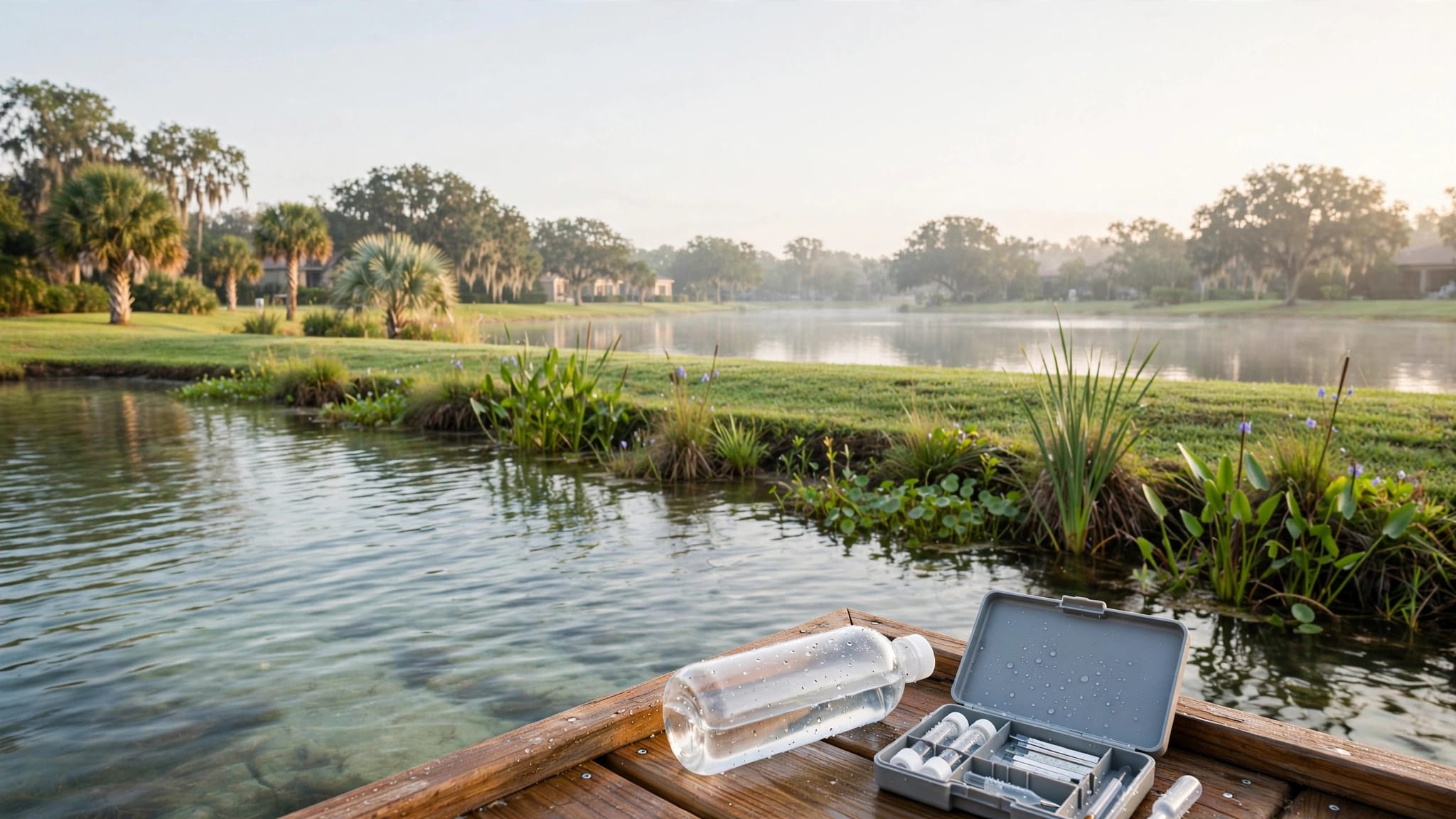
Start from the bank, a boardwalk, or another stable access point. Retention ponds may have steep edges, soft sediment, drop-offs, contaminated runoff, alligators, and submerged equipment. Residents should not wade into a pond to collect a sample.
Use a pole-mounted viewing tool or a trained aquatic plant rake when conditions allow. Any collected material should stay contained. Do not drag vegetation through the neighborhood, leave fragments on the bank, or move equipment between lakes without cleaning it.
Record the inspection date, water level, weather, and location of each patch. Mark areas on a property map, satellite image, or lake maintenance log. Photos should include:
- The patch from the shoreline.
- A close view of leaf shape and arrangement.
- The stem node and leaf attachment.
- The underside of any floating leaf.
- A flower spike, if present.
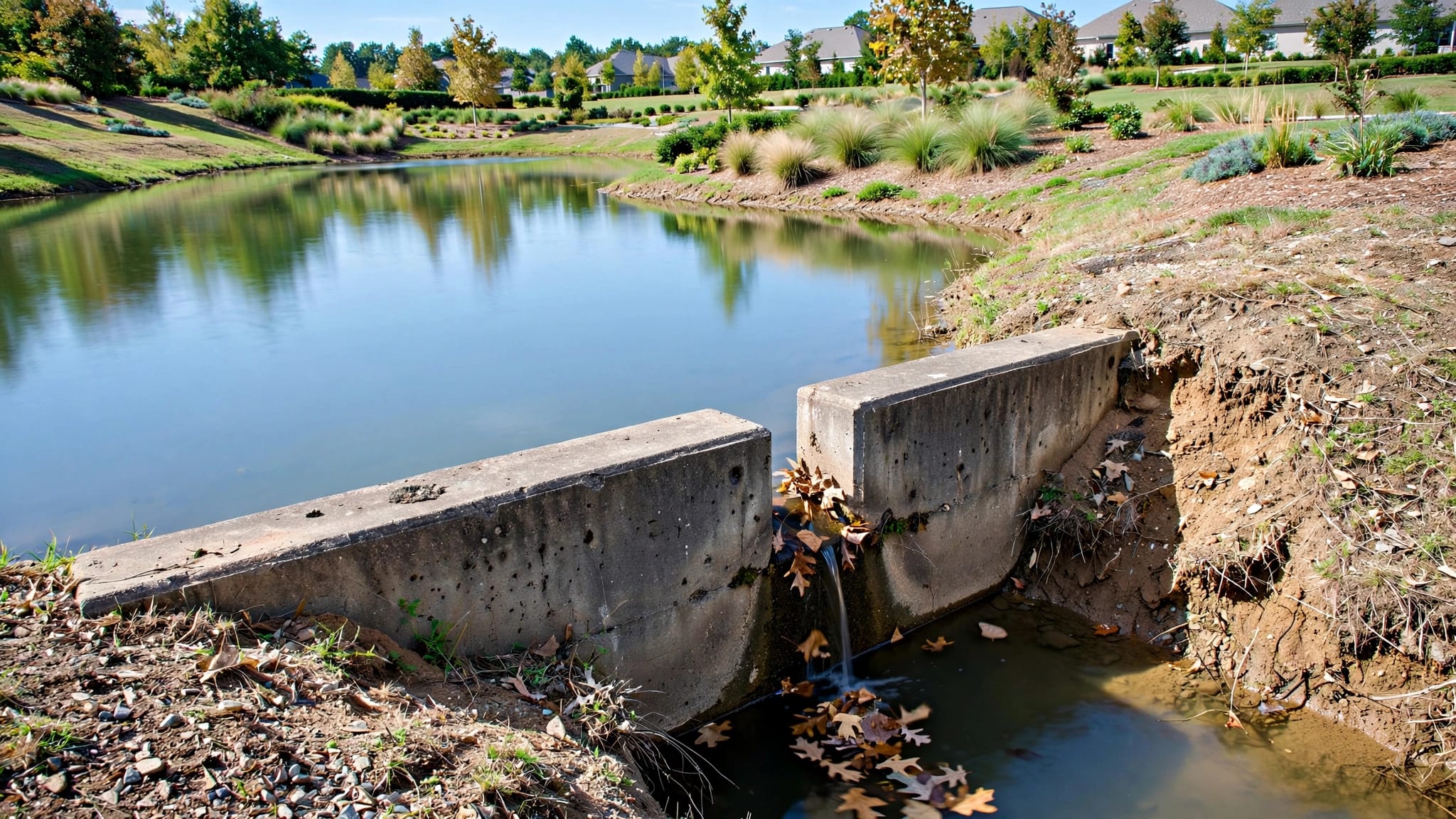
- Nearby inlets, outfalls, spillways, and pump structures.
Inspect more than the most visible bank. Growth often appears first where water movement slows, sediment accumulates, or nutrients enter the lake. Check stormwater inflows after heavy rain and inspect outfalls for fragments carried between water bodies.
On multi-lake properties, a small patch in one pond can become a property-wide issue. How lake connectivity spreads weeds across community lakes explains why crews monitor inlets, outlets, debris, and weak-circulation areas.
When pondweed needs control
A small underwater patch doesn't always require immediate eradication. The right decision depends on the lake's purpose, the plant's location, its growth rate, and the community's maintenance standards.
Control becomes more urgent when pondweed:
- Restricts flow through an inlet, outlet, spillway, or pump intake.
- Forms surface growth beside sidewalks, docks, or golf course playing areas.
- Spreads rapidly between inspection visits.
- Blocks views of the water or creates a safety concern.
- Traps floating debris near a drainage structure.
- Dies back in large quantities and creates an oxygen demand.
- Appears with algae, cloudy water, erosion, or heavy nutrient runoff.
Mechanical removal can work for limited patches when crews collect all cut material. It becomes less practical as rooted growth covers a large area. Pulling or cutting without collecting fragments may spread the problem.
Selective aquatic herbicides can control certain plants when the applicator identifies the species, measures the treatment area, and follows the product label. Water-use restrictions and application rules vary by product and site. Only a properly licensed professional should make that decision for a community lake.
A lake may also need supporting work. Reducing nutrient runoff, repairing erosion, removing debris, and improving circulation can reduce the conditions that support repeated growth. Aeration can improve oxygen and circulation, but it isn't a stand-alone cure for rooted pondweed.
Established plants may need follow-up work because roots and underground structures survive incomplete treatments. See why mature aquatic weeds resist treatments before assuming that one clear shoreline means the issue has ended.
Florida seasons change what you see
Florida's warm water allows many aquatic plants to remain active for much of the year. Growth still changes with rainfall, water level, sunlight, temperature, and nutrient movement.
During the drier season, lower water levels can expose shallow banks and make erosion, clogged structures, and new plant patches easier to inspect. Crews can also identify areas where sediment has collected.
The wet season brings a different set of concerns. Heavy rain moves nutrients and plant fragments through stormwater systems. Water levels rise, inflows become stronger, and growth near outfalls can expand quickly. A storm may also spread vegetation from one lake into another.
The Florida lake maintenance calendar provides a useful framework for adjusting inspections throughout the year.
Service frequency should match site pressure. Many HOA lakes can begin with monthly inspections, while properties with fast growth, connected ponds, frequent runoff, or sensitive structures may need weekly or biweekly attention. How often HOA lakes need service covers the factors that affect that schedule.
What to ask a lake maintenance contractor
A qualified contractor should identify the plant before recommending control. Ask for photographs, a map of affected areas, and a clear explanation of which vegetation will remain.
The service plan should also describe how the crew will protect littoral plants, fish habitat, shoreline access, and stormwater structures. Ask how the contractor will collect debris and monitor the lake after treatment.
For Florida communities, confirm that the applicator holds the proper license for aquatic weed work. Seabreeze Lake Maintenance holds Commercial Applicator License #CM28291 and State-Licensed Specialty Contractor #SCC131152136 .
A useful maintenance report should show the inspection date, areas treated, plant type, water conditions, visible changes, and recommended follow-up. That record helps board members track recurring problem areas and budget for routine work instead of emergency removal.
Seabreeze also provides aquatic weed and algae control, water-quality management, aeration, debris removal, shoreline inspections, erosion control, and ongoing maintenance for Southwest Florida communities. HOA boards, golf courses, and property managers can Get a Free Lake Health Assessment to schedule a lake inspection and discuss the right maintenance plan.
Ask whether shoreline or littoral planting work includes written workmanship terms. Seabreeze lists a lifetime warranty on littoral plants and workmanship, which gives property managers a clear point to review before approving that work.
Conclusion
Accurate Florida pondweed identification begins with the plant's structure, not its color. Check the leaf arrangement, stem nodes, floating and submerged forms, roots, and growth location before choosing control.
For a community lake, the best plan also tracks inlets, outfalls, water quality, seasonal changes, and connected ponds. Early identification keeps a small patch manageable and helps protect the drainage function, appearance, and safety of the entire property.
Recent Posts